
Introduction
The digital landscape of the gaming industry has evolved beyond simple web pages and static layouts. Today, operators, publishers, and affiliates face unique technology challenges when building and managing modern casino and iGaming websites. Managing large volumes of structured content—ranging from extensive game libraries and detailed reviews to complex bonus terms, promotional structures, and dynamic payment listings—requires robust digital infrastructure.
Beyond content volume, digital teams must navigate strict search engine optimization (SEO) requirements, multi-market localization, rapid content updates, and seamless third-party API integrations. Whether you are managing an editorial publishing portal, an affiliate network, or an operator ecosystem, selecting the right digital architecture is critical for long-term scalability and operational efficiency.
Platforms such as CasinoBullseye.com serve as dedicated research resources for professionals exploring casino CMS, iGaming software, casino management systems, and related technology. This guide breaks down the core components of modern casino technology, examining software categories, system integrations, security practices, and practical evaluation frameworks.
Understanding Casino CMS
A casino CMS (Content Management System) is a specialized digital publishing platform designed to handle the complex, data-heavy content models inherent to the gaming industry. Unlike generic publishing tools, a specialized CMS accommodates intricate data relationships, such as linking software providers to specific game titles, associating payment gateways with regional availability, and organizing promotional terms with strict metadata requirements.
Specialized systems help organizations systematically organize and manage:
- Casino Listings & Brand Profiles: Detailed overviews, operational histories, and compliance notes.
- Game Information Databases: Titles, volatility metrics, return-to-player (RTP) figures, categories, and provider details.
- Bonuses & Promotions: Structured campaigns, wagering requirements, expiration dates, and geographic restrictions.
- Payment Methods: Deposit and withdrawal options, processing times, fees, and currency supports.
- Reviews, Ratings, & Comparison Matrices: Dynamic tables and scoring systems.
- Guides, Articles, & Landing Pages: Editorial content mapped to search intent and user funnels.
While a generic CMS can be heavily customized, a purpose-built or tailored framework reduces administrative overhead, streamlines editorial workflows, and maintains consistent schema markup across thousands of dynamic pages.
Casino Content Management System
The day-to-day role of a casino content management system extends far beyond simple text editing. It acts as the operational nerve center for editorial, SEO, and marketing teams.
Core Capabilities
- Structured Content & Taxonomies: Separating content from presentation allows teams to update a single database entry (such as a payment method or game feature) and automatically reflect that change across every review, guide, and comparison table on the site.
- Editorial Workflows & User Roles: Granular permissions ensure that content creators, editors, compliance reviewers, and administrators operate within controlled publishing pipelines.
- Media & Asset Management: Centralized repositories for game banners, provider logos, promotional graphics, and responsive image assets.
- Advanced SEO Fields: Native support for automated meta descriptions, customized URL slugs, Open Graph tags, and structured data schema.
- Localization & Regionalization: Managing multi-language variants and region-specific content variations without duplicating entire site structures.
As a gaming or publishing website scales, structured content prevents editorial bottlenecks, reduces human error, and ensures high consistency across large inventories.
Casino Website Software
The term “casino website software” encompasses the broader stack of technologies that power the front-end user experience and back-end data delivery. It is vital to make a clear distinction between website content infrastructure and player-facing gaming/operator infrastructure.
Website software typically includes:
- Front-End Interfaces: Responsive templates, frameworks, and user experience layouts.
- Content APIs: Headless or decoupled delivery mechanisms serving data across web and mobile applications.
- Search and Filtering Engines: High-speed indexing tools that allow users to search games, bonuses, and reviews instantly.
- Analytics and Tracking Layers: Performance monitoring, user behavior analysis, and conversion tracking tools.
In contrast, player-facing operator infrastructure involves remote gaming servers (RGS), player account management (PAM) systems, secure wallet integrations, and real-time betting engines. While affiliate and publishing sites rely heavily on content infrastructure, operators manage a dual architecture combining content management with secure transactional gaming platforms.
Casino Management Software
In practical business terms, “casino management software” can refer to vastly different technology categories depending on whether the business operates online or within a land-based property.
For online operations, management software often refers to backend suites handling customer relationship management (CRM), promotional segmentation, player support ticketing, and reporting dashboards. For land-based or hybrid venues, it encompasses casino management systems (CMS) that track floor operations, slot machine telemetry, table games tracking, cage operations, and loyalty programs.
Modern digital businesses integrate multiple specialized systems rather than relying on a single monolithic tool, connecting content layers with CRM, analytics, payment gateways, and customer support desks through secure APIs.
Casino Management Systems
Broadly speaking, enterprise casino management systems unite disparate operational touchpoints into cohesive administrative overviews. Common capabilities found across various vendor ecosystems include:
- Player Data & CRM: Tracking engagement, segmentation, and lifecycle marketing campaigns.
- Reporting & Business Intelligence: Aggregating transactional, operational, and traffic data into actionable insights.
- Promotional Engines: Managing bonus distribution, loyalty tiers, and automated reward triggers.
- Security & Access Control: Multi-factor authentication, audit logging, and role-based permissions.
Because capabilities vary significantly by platform and vendor, organizations must evaluate whether a system’s native modules meet their operational requirements or if third-party integrations are necessary.
iGaming Software
Within the digital gaming technology ecosystem, iGaming software represents the overarching umbrella of applications required to run online gaming operations and supporting digital properties.
Key technical components include:
- Casino Platforms & Aggregators: Software layers connecting game studios with operator front-ends.
- Account Management & Wallet Systems: Secure databases handling user profiles, balances, and transaction histories.
- Payment Gateways: Integrations processing fiat and alternative payment methods.
- Responsible-Gaming and Compliance Tools: Self-exclusion registries, deposit limit enforcers, and age-verification APIs.
Maintaining a technology-focused perspective ensures that development and operations teams select modular, scalable software capable of adapting to regulatory shifts.
iGaming CMS
An iGaming CMS is specifically tailored to address the high-velocity publishing demands of online gaming portals, news sites, and affiliate platforms. Because these sites often feature thousands of rapidly changing game reviews, shifting promotional offers, and fluctuating regulatory notices, standard publishing setups frequently fall short.
An effective iGaming CMS provides robust API connectivity, flexible custom content types, high-performance caching layers to handle traffic spikes, and strict version control. These features ensure that editorial updates can be deployed rapidly without compromising site performance or exposing outdated promotional terms.
Casino Platform Software
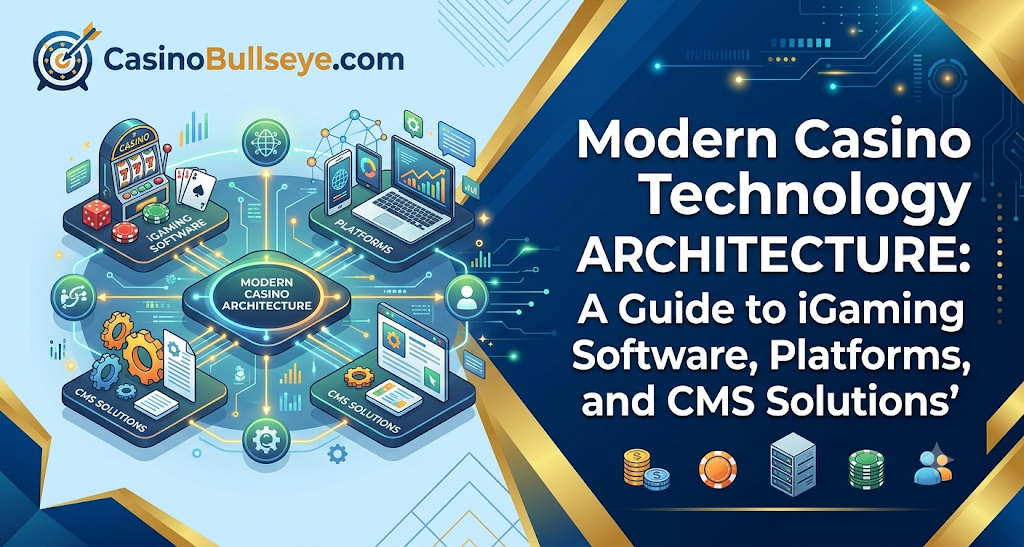
Casino platform software operates as the foundational middleware connecting disparate digital systems. A typical architecture flows from the website and CMS layer through content APIs and game aggregators into core account systems, payment processors, CRM pipelines, and analytics suites.
[Website / Front-End]
       ↕
[CMS & Content APIs]
       ↕
[Platform Middleware / Aggregators]
       ↕
[Account Systems, Payments, CRM, Analytics]
APIs (Application Programming Interfaces) serve as the connective tissue in this architecture. Well-documented RESTful or GraphQL APIs allow technical teams to swap out modules—such as changing a payment gateway or upgrading a CRM—without disrupting the entire technology stack.
Important Features to Evaluate in Casino Software
When researching and procuring technology, decision-makers should apply a structured evaluation framework:
| Evaluation Criteria | Key Focus Areas |
| Content Management | Handling structured types, taxonomies, and relational data. |
| Scalability | Supporting growing content libraries, traffic surges, and database expansion. |
| Integrations | Robust API availability and seamless third-party connectivity. |
| Security | Access controls, encryption standards, and secure development lifecycles. |
| SEO Support | Metadata customization, clean URL structures, and high page performance. |
| Analytics & Reporting | Data visibility, logging capabilities, and operational transparency. |
| Localization | Multi-language support, regional content variations, and currency handling. |
| Workflow Management | Editorial roles, approval chains, and revision histories. |
Integrations in iGaming Software
No single software vendor provides an all-in-one solution that satisfies every operational need. Consequently, integrations are a foundational pillar of modern iGaming architecture.
- Common Integration Categories: Payment processors, CRM platforms, game aggregators, identity verification (KYC) systems, customer support helpdesks, and analytics tools.
- Integration Challenges: Maintaining data consistency across systems, managing API rate limits, handling vendor downtime, and ensuring secure data transmission.
Robust middleware and careful API versioning help technical teams mitigate these challenges, ensuring system stability even when third-party dependencies experience updates.
Casino Software Security
Security is non-negotiable in digital technology architecture. Protecting sensitive data, user accounts, and administrative systems requires a defense-in-depth approach.
- Authentication & Authorization: Enforcing multi-factor authentication (MFA) and strict role-based access control (RBAC).
- Data Protection: Encrypting data both in transit (using TLS 1.3) and at rest (using advanced encryption standards like AES-256).
- API Security: Implementing rate limiting, token-based authentication (such as OAuth 2.0), and rigorous input validation to prevent injection attacks.
- Monitoring & Auditing: Comprehensive logging, automated vulnerability scanning, regular backup routines, and tested disaster recovery plans.
Organizations must prioritize secure coding practices and continuous compliance monitoring to protect digital assets against evolving threats.
SEO and Content Management for Casino Websites
For publishers, affiliates, and operators alike, organic search visibility relies heavily on technical execution and content flexibility. A specialized CMS supports organic performance by offering:
- Clean URL Structures: Predictable, human-readable permalink hierarchies.
- Automated Schema Markup: Injecting structured data (such as Review, Organization, and Breadcrumb lists) to help search engines understand page context.
- Page Performance Optimization: Efficient asset delivery, server-side rendering (SSR), and advanced caching mechanisms to maintain fast loading speeds.
- Internal Linking Architectures: Automated or template-driven cross-linking between related reviews, guides, and game categories.
Note: While robust software and CMS architecture lay the technical foundation for search visibility, ultimate search engine rankings depend on multiple external factors, algorithm updates, and content quality.
Choosing the Right Casino CMS or iGaming Software
Selecting the appropriate software requires aligning technical capabilities with business objectives. Decision-makers should evaluate:
- Business Model & Scope: Clarify whether the platform serves an editorial publishing model, an affiliate network, or an operator ecosystem.
- Technical Architecture: Assess whether a headless CMS, monolithic platform, or custom-built solution best fits existing engineering resources.
- Total Cost of Ownership (TCO): Weigh licensing fees, hosting infrastructure, ongoing maintenance, and internal development costs.
- Compliance Readiness: Ensure the software aligns with applicable data protection regulations and regional jurisdictional requirements.
Casino CMS vs. General-Purpose CMS
| Factor | Casino / iGaming CMS | General-Purpose CMS |
| Structured Casino Content | Native, purpose-built schemas for games, bonuses, and payments. | Requires heavy plugin customization or custom post types. |
| Specialized Workflows | Tailored editorial and compliance review pipelines. | Standard publishing workflows; requires customization for gaming content. |
| Gaming-Related Integrations | Pre-built or easily adaptable API connections for data feeds. | Requires bespoke API development for gaming data feeds. |
| Flexibility | Optimized for relational game, review, and bonus data models. | Highly flexible for general blogging and corporate sites, but rigid for niche data structures. |
| Customization | Built with gaming taxonomy requirements in mind from inception. | Highly customizable via community plugins, which can introduce security overhead. |
| Maintenance | Specialized updates focused on gaming data structures and API stability. | Broad ecosystem updates; requires vigilant plugin dependency management. |
| Scalability | Architected for large, complex relational content catalogs and high traffic. | Scalable, but performance degrades on large relational catalogs without tuning. |
Neither option is universally superior; the right choice depends entirely on an organization’s specific technical requirements, internal engineering capacity, and content complexity.
Online Casino Technology vs. Land-Based Casino Technology
While both sectors share high standards for security and reporting, their underlying technology stacks differ significantly.
- Online Environments: Rely on web applications, cloud infrastructure, REST/GraphQL APIs, remote databases, digital payment gateways, and content platforms. High emphasis is placed on low-latency web delivery, mobile responsiveness, and continuous software deployment cycles.
- Land-Based Environments: Rely on physical property networks, on-premise servers, slot accounting systems, point-of-sale (POS) terminals, and physical security infrastructure. High emphasis is placed on hardware reliability, physical access control, and closed-loop local networking.
While some management tools bridge both worlds (such as enterprise CRM systems), the core operational architecture of online and land-based properties remains distinct.
Responsible Gaming and Compliance Considerations
Digital iGaming technology often intersects with regulatory frameworks. Modern software solutions frequently incorporate features designed to support compliance workflows, including:
- Age and identity verification (KYC) API hooks.
- Responsible-gaming controls, such as self-exclusion flags and deposit-limit tracking.
- Data-protection measures complying with privacy regulations (such as GDPR).
- Audit logging to support regulatory reporting requirements.
Disclaimer: This overview is for informational and technological education purposes only and does not constitute legal or regulatory advice. Organizations operating in the gaming sector should consult qualified legal and compliance professionals to ensure adherence to laws in their specific jurisdictions.
Common Mistakes When Selecting Casino Software
Technology procurement can easily derail if organizations fall into common operational traps:
- Choosing Solely on Price: Selecting the cheapest software often leads to hidden customization costs, poor scalability, and security vulnerabilities.
- Underestimating Integrations: Failing to analyze API limitations and data synchronization requirements between systems.
- Neglecting Editorial Workflows: Choosing software that slows down content teams with clunky interfaces and rigid publishing constraints.
- Overlooking Security and Maintenance: Ignoring regular patch management, backup protocols, and scalable cloud infrastructure.
- Failing to Define Requirements: Purchasing platforms without mapping out current and future business needs.
How CasinoBullseye.com Helps Technology Researchers
Navigating the crowded landscape of gaming technology requires reliable, structured information. CasinoBullseye.com acts as an educational hub designed to help developers, operators, publishers, and technology leaders research software solutions effectively.
Whether you are exploring modular casino CMS platforms, evaluating casino management software, reviewing iGaming software architectures, or comparing content management systems, the platform provides clear, objective insights into digital infrastructure within the iGaming industry.
Frequently Asked Questions
- What is a casino CMS?A casino CMS is a specialized content management system designed to organize and publish data-heavy gaming content, such as game libraries, bonus terms, payment options, and review matrices, with built-in relational database structures.
- What is casino management software?Casino management software refers to digital tools and backend suites used to handle operations, customer relationship management (CRM), promotional campaigns, reporting, and analytics within gaming businesses.
- What is iGaming software?iGaming software is the broad category of digital platforms, account management systems, payment gateways, game aggregators, and compliance tools that power online gaming operations.
- What is an iGaming CMS?An iGaming CMS is a content management platform optimized for gaming publishers, affiliates, and operators, featuring advanced API connectivity, multi-market localization, and high-performance caching for structured content.
- What is casino website software?Casino website software encompasses the front-end interfaces, content APIs, search indexing tools, and supporting infrastructure that deliver web-based gaming and publishing experiences to users.
- What is casino platform software?Casino platform software acts as the foundational middleware layer that connects websites, CMS layers, game content, account systems, payments, and CRM tools via APIs.
- What features should casino management systems provide?Key features typically include player data management, reporting and business intelligence dashboards, promotional engines, security controls, and integration APIs, though exact capabilities vary by vendor.
- How does a casino CMS differ from a general CMS?A casino CMS offers native data structures and workflows tailored specifically for gaming content (like games, odds, and bonus terms), whereas a general CMS requires heavy plugin customization to achieve similar relational data organization.
- Why are integrations important in iGaming software?Because no single software vendor provides an all-in-one solution, integrations via APIs allow businesses to connect specialized payment gateways, CRM tools, game aggregators, and analytics platforms seamlessly.
- What security features should casino software include?Essential security features include multi-factor authentication, role-based access control, data encryption in transit and at rest, secure API authentication, comprehensive logging, and regular vulnerability monitoring.
Conclusion
Selecting and implementing the right technology stack is a foundational determinant of success for modern casino and iGaming businesses. From robust CMS architecture and scalable software to rigorous security practices, clean API integrations, and structured content management, every technical decision impacts operational efficiency and long-term growth.
By prioritizing technical accuracy, scalability, and secure development practices, organizations can build resilient digital ecosystems. Explore the resources on CasinoBullseye.com to deepen your understanding of casino CMS platforms, iGaming software, and modern casino management systems.

