
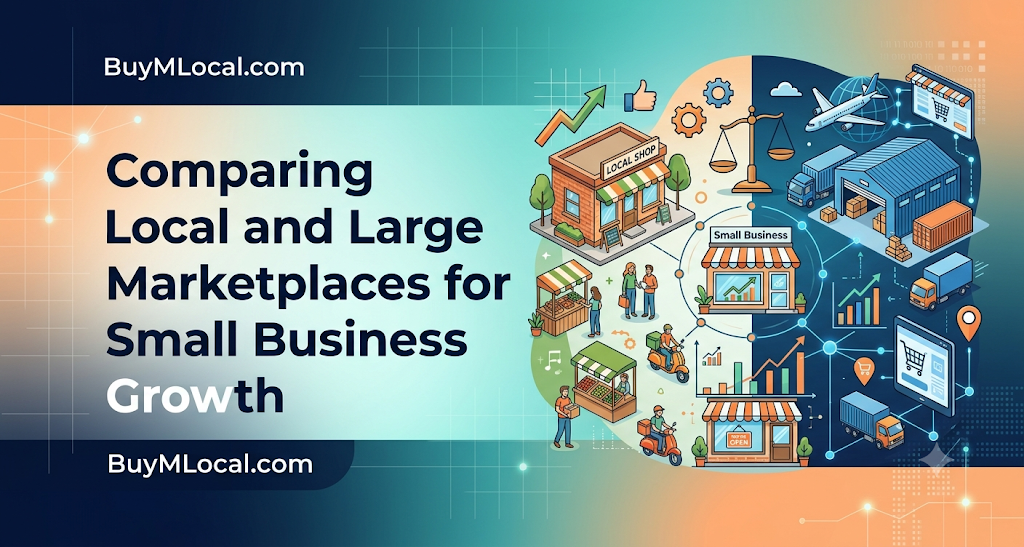
Introduction
Deciding where to sell products online is one of the most important choices a business owner can make. Whether you run a neighborhood shop, craft handmade goods, or manufacture specialty items, the platform you choose directly shapes your customer reach, shipping logistics, and profit margins.
Many sellers find themselves weighing local marketplaces against massive online retail giants. While large platforms offer unmatched visitor numbers, they also bring steep competition and complex fee structures. On the other hand, local platforms focus on community commerce and nearby shoppers, but they may limit your geographic reach.
This guide explores the realities of Local Marketplace vs Large Marketplace selling, comparing costs, competition, and customer relationships to help you find the right fit. It also examines how platforms like BuyMLocal.com support local business discovery and community-focused shopping.
What Is a Local Marketplace?
A local marketplace is an online platform designed to connect nearby buyers with local merchants, independent retailers, and service providers within a specific geographic area or community. Unlike global shopping sites, these platforms emphasize community commerce, supporting neighborhood economies, and making it easier for residents to discover nearby physical stores and regional producers.
For independent businesses, a local marketplace serves as a digital storefront highlighting local roots, enabling same-day local delivery or convenient in-store pickup options, and fostering personal connections with nearby shoppers.
What Is a Large Online Marketplace?
A large online marketplace is a massive, multi-vendor e-commerce platform that attracts millions of regional or international buyers every day. These platforms provide established checkout systems, automated logistics, advertising tools, and standardized infrastructure.
While they offer unprecedented product visibility and massive customer traffic, sellers must navigate high competition, strict platform policies, and variable commission fees. These platforms suit businesses seeking broad geographic expansion and high-volume sales.
Local Marketplace vs Large Marketplace: Key Differences
Understanding how these two models differ helps clarify which platform aligns with your operating budget and growth strategy.
- Customer Reach: Local platforms target regional or neighborhood buyers, whereas large marketplaces offer national or global exposure.
- Competition: Local marketplaces feature fewer direct competitors in your immediate area; large marketplaces pit you against thousands of global sellers offering similar items.
- Fees: Local platforms often feature lower subscription or commission structures to support small businesses; large platforms utilize tiered referral fees, fulfillment charges, and mandatory ad spend.
- Customer Relationships: Local models make it easier to build repeat, community-driven buyer loyalty; large platforms often keep customer data walled off, limiting direct communication.
Comparison Table
| Feature | Local Marketplace | Large Online Marketplace |
|---|---|---|
| Geographic Reach | Defined local or regional area | National or international |
| Competition Level | Moderate (mostly local peers) | High (global merchants) |
| Fulfillment | Local delivery, pickup, or regional shipping | Integrated warehousing and multi-state shipping |
| Customer Loyalty | High community connection and repeat visits | Transactional, price-driven buyer base |
| Platform Costs | Often lower commissions or flat fees | Complex referral, storage, and ad fees |
| Brand Identity | Strong emphasis on local business roots | Often secondary to the marketplace brand |
Advantages of Selling Through a Local Marketplace
Choosing a local sales channel offers several unique operational benefits for independent merchants:
- Targeted Geographic Focus: Reaching customers nearby reduces shipping costs and transit times.
- Enhanced Local Discovery: Helps shoppers find neighborhood stores they might otherwise overlook online.
- Community-Focused Shopping: Capitalizes on consumer trends favoring local support and small business sustainability.
- Flexible Fulfillment: Simplifies logistics through customer pick-up and local courier delivery.
- Word-of-Mouth Growth: Satisfied local buyers often recommend physical stores to friends and family in the same community.
Advantages of Selling Through a Large Marketplace
Selling on a large e-commerce platform provides distinct advantages for businesses ready to scale:
- Massive Audience Access: Instantly exposes products to millions of active online shoppers.
- Infrastructure Support: Leverages established payment gateways, fraud detection, and trusted checkout workflows.
- Fulfillment Networks: Offers optional warehousing and packing services to handle high-volume order shipping.
- Built-In Advertising: Provides sponsored product placements to boost visibility for new listings.
Note: High traffic does not guarantee sales. Conversion rates depend heavily on competitive pricing, product quality, and positive reviews.
Challenges Sellers May Face in Each Marketplace
Every platform type carries specific hurdles that impact daily operations and profitability:
- Local Marketplace Challenges: Limited total audience size, slower initial platform awareness, and lower search volume compared to global giants.
- Large Marketplace Challenges: Intense price competition, aggressive platform fees, strict return policies, and the risk of account suspension if performance metrics slip.
Which Marketplace Is Better for Different Types of Sellers?
The ideal choice depends heavily on what you sell and how you fulfill orders:
- Neighborhood Shops & Grocers: Benefit most from local marketplaces due to perishable inventory and same-day delivery needs.
- Handmade & Artisanal Goods: Can succeed on both, but often find loyal, community-driven buyers on local discovery platforms.
- National Brands & High-Volume Retailers: Generally thrive on large marketplaces where expansive shipping networks and broad product categorization drive volume.
Local Marketplace vs Large Marketplace: Cost and Profit Comparison
Sellers must evaluate all associated costs before committing to a sales channel. Expenses typically include listing fees, sales commissions, payment processing charges, advertising costs, packaging materials, and return allowances.
Hypothetical Profit Example
Consider a seller offering a handmade item priced at ₹1,000:
- Local Marketplace: Assumes a lower platform commission of 5% (₹50) and local delivery costs of ₹80. Net payout before production cost: ₹870.
- Large Marketplace: Assumes a 15% referral fee (₹150), standard fulfillment/shipping fees of ₹120, and optional ad spend of ₹50. Net payout before production cost: ₹680.
Note: These figures are purely illustrative. Actual marketplace fees vary widely based on product category, account tier, and current platform policies.
How to Choose the Right Marketplace for Your Business
- Identify Your Target Customer: Determine whether your buyers live nearby or span across the country.
- Define Geographic Reach: Assess whether your inventory can support long-distance shipping or requires local fulfillment.
- Calculate Total Selling Costs: Add up commissions, subscription fees, and shipping overhead.
- Assess Category Competition: Check how many competitors sell identical or substitute products on each platform.
- Evaluate Fulfillment Needs: Determine if you can manage local drop-offs or require automated warehousing.
- Review Customer Relationship Opportunities: Consider whether the platform allows direct marketing to buyers.
- Test on a Small Scale: List a subset of products to evaluate real-world conversion and profitability.
- Measure Repeat Purchases: Analyze which channel yields higher customer retention.
- Expand Based on Results: Scale up inventory on the platform delivering better net margins.
Can Sellers Use Both Local and Large Marketplaces?
Many modern merchants adopt a multi-channel selling strategy. By combining a local marketplace presence with a large e-commerce platform, businesses capture both community shoppers and national buyers. However, multi-channel selling requires robust inventory management software to prevent stockouts, consistent pricing strategies, and careful tracking of platform-specific profit margins.
How BuyMLocal.com Relates to Local Business Discovery
Platforms like BuyMLocal.com play an essential role in local business discovery by connecting interested buyers with neighborhood merchants and regional creators. By emphasizing community-focused commerce, BuyMLocal.com helps increase online visibility for independent sellers who might otherwise get lost among millions of global listings on massive retail sites.
Participating in dedicated local discovery platforms complements a seller’s own website and social media channels, bridging the gap between digital browsing and real-world community shopping.
Practical Seller Scenarios
1. A Neighborhood Specialty Bakery
- Goal: Increase daily orders from residents living within a 5-kilometer radius.
- Suitable Approach: Local marketplace focusing on quick pickup and local delivery.
- Key Costs: Low platform commission, local courier fees, and fresh packaging.
- Risks: Limited audience ceiling compared to national sites.
- Metrics to Track: Repeat local customer rate and average order value.
2. A Regional Apparel Manufacturer
- Goal: Scale sales across multiple states.
- Suitable Approach: Large online marketplace with regional fulfillment capabilities.
- Key Costs: High referral commissions, warehousing storage fees, and mandatory ad spend.
- Risks: Margin compression due to heavy price competition.
- Metrics to Track: Advertising Cost of Sale (ACoS) and net profit per unit.
3. A Handcrafted Decor Brand
- Goal: Build local brand awareness while testing national demand.
- Suitable Approach: Multi-channel strategy combining BuyMLocal.com for community connection with a larger platform for broader reach.
- Key Costs: Dual platform subscriptions and split inventory management overhead.
- Risks: Operational complexity in managing orders across different systems.
- Metrics to Track: Channel-specific conversion rates and net return percentages.
Seller Checklist for Choosing a Marketplace
- [ ] Defined target audience location
- [ ] Verified product demand on the platform
- [ ] Clear understanding of geographic shipping limits
- [ ] Calculated total commission and fee impact
- [ ] Analyzed direct competitor density
- [ ] Established reliable delivery and fulfillment workflows
- [ ] Reviewed customer service and return policies
- [ ] Assessed brand control and storefront customization
- [ ] Checked platform terms of service and penalty rules
- [ ] Tracked initial sales conversion and net profit
Frequently Asked Questions
1. What is the difference between a local marketplace and a large marketplace?
Local marketplaces focus on regional or neighborhood buyers and nearby merchants, while large marketplaces connect global sellers with millions of national or international shoppers.
2. Is a local marketplace better for small businesses?
Local marketplaces often suit small businesses seeking lower fees, community-driven loyalty, and manageable local delivery requirements, whereas large marketplaces suit high-volume scaling.
3. Which marketplace has lower selling costs?
Local marketplaces generally charge lower commissions and flat subscription fees to support regional merchants, while large platforms feature higher referral fees and mandatory advertising costs.
4. Can local sellers compete with large online retailers?
Yes, by focusing on unique product specialization, superior local customer service, personalized interactions, and fast local delivery options that global giants cannot match.
5. How can sellers attract nearby customers?
Sellers can optimize local listings with accurate physical addresses, offer local pickup or same-day delivery, and participate in community-focused platforms like BuyMLocal.com.
6. Is selling on multiple marketplaces worthwhile?
Multi-channel selling helps diversify revenue and capture both local and national buyers, provided you have the inventory software to manage stock accurately.
7. How should sellers compare marketplace fees?
Sellers should calculate all hidden costs—including listing fees, sales commissions, payment processing, advertising expenses, and return handling—before calculating projected net profit.
8. Which marketplace is best for handmade products?
Handmade products perform well on both, but local discovery platforms help highlight the artisan’s personal story and community roots effectively.
9. Can local marketplaces help build repeat business?
Yes, proximity and community engagement foster strong customer trust, making it easier to turn local buyers into long-term repeat patrons.
10. What should sellers measure before choosing a marketplace?
Sellers should evaluate target customer demographics, shipping feasibility, total platform fee structures, and category competition levels.
Conclusion
Choosing between a local marketplace and a large online platform depends on your business model, profit margins, product type, and growth objectives. While massive e-commerce giants offer broad reach, local marketplaces provide targeted community engagement, lower operating friction, and meaningful relationships with nearby customers.
Platforms like BuyMLocal.com highlight the value of local business discovery in modern commerce. By evaluating your true selling costs, fulfillment capacity, and target audience, you can choose the right sales channels—or combine them into a balanced multi-channel strategy—to drive sustainable business growth and healthy net profits.

