
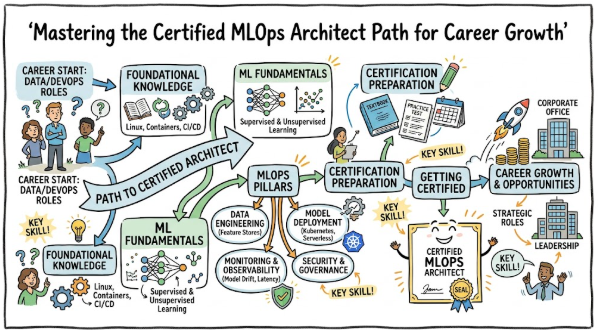
The technological landscape is moving rapidly toward automated, intelligent, and highly scalable systems. As production environments grow in complexity, the chasm between raw data science experiments and robust, reliable machine learning services has become a major challenge for many companies. The Certified MLOps Architect program is built to navigate this space, offering engineers the essential blueprint to architect, deploy, and maintain machine learning workflows at scale. Whether you are shifting your focus from standard DevOps practices or aiming to solidify your standing in data-centric operations, this guide highlights how aiopsschool can serve as a vital stepping stone for your professional trajectory.
What is the Certified MLOps Architect?
The Certified MLOps Architect credential serves as an expert validation of an engineer’s proficiency in managing the full machine learning lifecycle within intricate production settings. Unlike academic programs that focus solely on theory, this certification prioritizes the tactical, operational elements: continuous integration, automated deployments, real-time observability, and self-triggering retraining loops. It exists because the industry has matured beyond the “model-in-a-notebook” phase and now requires “ML as a robust service.” It perfectly matches the requirements of modern enterprises that need to keep their AI models performant, secure, and ready for continuous production updates.
Who Should Pursue Certified MLOps Architect?
This curriculum is tailored for systems engineers, DevOps practitioners, and Site Reliability Engineers who are responsible for taking machine learning solutions from development to production. It is also an excellent fit for data engineers looking to master the infrastructure layer of their data products and cloud architects tasked with building dedicated AI platforms. Whether you are early in your technical journey or a seasoned team lead aiming to standardize your operational approach, this path provides an actionable roadmap. It is highly pertinent for professionals in both global markets and the burgeoning Indian tech sector, where digital transformation is driving a massive need for qualified ML infrastructure experts.
Why Certified MLOps Architect is Valuable Today
In a world where infrastructure automation is the primary driver of organizational efficiency, the Certified MLOps Architect title confirms that you possess the skills to resolve the unique hurdles of machine learning, such as data drift, model degradation, and pipeline consistency. As adoption of AI accelerates, the market demand for engineers who understand the “plumbing” of intelligent systems is growing exponentially. This certification keeps your skillset sharp by concentrating on architectural fundamentals that remain effective regardless of which specific tools become popular. It offers a clear return on investment by positioning you as the essential bridge between siloed data science teams and core infrastructure engineering.
Certified MLOps Architect Certification Overview
The certification process is offered via Certified MLOps Architect and is hosted on aiopsschool. The assessment is rigorous, designed to gauge your technical intuition and your capability to design systems that tackle complex, real-world problems. The structure ensures that successful candidates possess the practical grit required for high-stakes enterprise deployments. Earning this credential indicates to hiring managers that you have advanced past simple introductory exercises and have tackled the nuances of production-grade infrastructure, marking you as an engineer capable of handling mission-critical systems.
Certified MLOps Architect Certification Tracks & Levels
The certification roadmap is stratified to support professionals at different stages of their growth. The foundation level focuses on core methodology and pipeline basics, ensuring a firm grasp of the MLOps lifecycle. The professional level expands into scalability, security, and complex model governance, tailored for those managing active production services. Advanced levels cater to architects tasked with defining organization-wide AI strategy and building cross-functional platforms. These tiers allow you to customize your learning journey to match your current role and your long-term career ambitions.
Complete Certified MLOps Architect Certification Table
| Track | Level | Who it’s for | Prerequisites | Skills Covered | Recommended Order |
| Foundation | Entry | Software Engineers | Coding & Linux basics | ML Lifecycles | First |
| Professional | Mid-Level | DevOps/SRE/Data Eng | 1+ Year hands-on | CI/CD & Pipeline Scalability | Second |
| Advanced | Expert | Architects/Managers | 3+ Years hands-on | ML Governance & Strategy | Third |
Detailed Guide for Each Certified MLOps Architect Certification
Certified MLOps Architect – Foundation Level
What it is
This certification confirms your fundamental grasp of the ML lifecycle, covering data acquisition, source control for models, and baseline deployment strategies. It creates the essential groundwork for succeeding in an AI-focused engineering squad.
Who should take it
Aspiring ML engineers, junior DevOps personnel, and recent graduates who have solid software engineering basics but limited experience in operationalizing machine learning.
Skills you’ll gain
- Mastery of MLOps lifecycle concepts.
- Versioning strategies for datasets and model artifacts.
- Introductory pipeline automation techniques.
- Fundamental monitoring for model performance.
Real-world projects you should be able to do
- Constructing an end-to-end model training workflow.
- Managing manual deployment of a production-ready model.
- Configuring alerts for model drift or performance drops.
Preparation plan
- 7–14 days: Focus on understanding the theoretical ML lifecycle and versioning patterns.
- 30 days: Dedicate time to hands-on labs focused on environment setup and basic script automation.
- 60 days: Analyze real-world case studies and practice building end-to-end workflows.
Common mistakes
Overemphasizing data science math rather than the operational deployment lifecycle. Ignoring the importance of containerization, which is critical for standardizing MLOps.
Best next certification after this
- Same-track: Certified MLOps Architect – Professional.
- Cross-track: Certified DataOps Engineer.
- Leadership: Certified Cloud Solutions Architect.
Choose Your Learning Path
DevOps Path
The DevOps track centers on automating the infrastructure layer that empowers machine learning models. It covers integrating standard CI/CD tooling with the unique deployment needs of ML. You will learn to containerize models and manage the lifecycle of the microservices that serve them, ensuring that AI components are maintained with the same high standards as traditional software.
DevSecOps Path
The DevSecOps track focuses on hardening the ML pipeline from input data to final deployment. It covers critical topics like mitigating model poisoning, ensuring data privacy, and managing access to sensitive training environments. It is ideal for engineers tasked with ensuring that AI systems are not only performant but also secure against emerging threats and compliance risks.
SRE Path
The SRE track is dedicated to the uptime, reliability, and scale of ML systems. It focuses on establishing Service Level Objectives for model serving and creating self-healing systems. Candidates learn how to balance latency, throughput, and error budgets, ensuring that the AI components remain a dependable part of the overall system architecture.
AIOps Path
The AIOps track involves leveraging machine learning models to streamline IT operations. It covers deploying models that detect anomalies in infrastructure logs, automating incident remediation, and optimizing resource usage. This is essential for SREs and Platform Engineers looking to move beyond static threshold alerts to a more intelligent, AI-assisted operations model.
MLOps Path
The MLOps track is the primary journey for those specializing in the entire ML lifecycle. It covers advanced topics like feature stores, automated experimental tracking, and intelligent model-serving strategies. This path develops engineers who can manage the continuous flow of data and code, maintaining long-term model accuracy and operational value.
DataOps Path
The DataOps track focuses on the data engineering side of the house. It covers data lineage, quality assurance, and the orchestration of complex data workflows. This is vital for engineers who need to ensure that the data feeding into training pipelines is clean, consistent, and delivered with low latency to sustain reliable model performance.
FinOps Path
The FinOps track investigates the financial efficiency of running ML at scale. It covers how to optimize compute resources for training and inference, providing engineers with the knowledge to balance model quality with cloud infrastructure expenses. This is ideal for those aligning technical architecture with fiscal responsibility.
Role → Recommended Certified MLOps Architect Certifications
| Role | Recommended Certifications |
| DevOps Engineer | Certified MLOps Architect – Foundation & Professional |
| SRE | Certified MLOps Architect – Professional |
| Platform Engineer | Certified MLOps Architect – Professional & Advanced |
| Cloud Engineer | Certified MLOps Architect – Foundation |
| Security Engineer | Certified MLOps Architect – Professional |
| Data Engineer | Certified MLOps Architect – Foundation & DataOps |
| FinOps Practitioner | Certified MLOps Architect – Professional |
| Engineering Manager | Certified MLOps Architect – Advanced |
Next Certifications to Take After Certified MLOps Architect
Same Track Progression
Upon mastering the professional level, the next natural move is the Advanced Certified MLOps Architect. This involves stepping into the realm of platform design, where you define organizational governance, infrastructure templates, and standard operating procedures for large-scale AI deployment.
Cross-Track Expansion
Consider exploring Certified DataOps or Certified FinOps. Since MLOps relies on the availability of high-quality data and the efficient use of cloud compute, these skills will make you a well-rounded architect capable of solving problems across the entire technology stack.
Leadership & Management Track
For those aiming for management roles, pursuing certifications in technical leadership or specialized management tracks is highly beneficial. These programs focus on team-building, strategy formulation, and the cultural changes required to foster an AI-first engineering organization.
Training & Certification Support Providers for Certified MLOps Architect
DevOpsSchool
A primary hub for engineering excellence, providing comprehensive training modules and career-focused learning paths for technical professionals.
Cotocus
Dedicated to deep-dive technical education, this provider offers practical, hands-on training that keeps pace with modern industry standards.
Scmgalaxy
Renowned for its precise approach to pipeline management and source control, this provider is ideal for mastering the fundamentals of automation.
BestDevOps
Specializing in the fusion of development and operations, this school delivers certifications focused on real-world, enterprise-ready engineering skills.
devsecopsschool
An expert entity focused on embedding security protocols within the development process, offering essential training for building resilient production systems.
sreschool
Focused on site reliability, this provider delivers specialized programs regarding system resilience, scalability, and automated incident response strategies.
aiopsschool
As the official host of the MLOps architect program, this institution specializes in applying intelligence to infrastructure and operational system management.
dataopsschool
This school focuses on the data engineering and pipeline management side, which is critical for those managing the data lifecycle in AI projects.
finopsschool
This provider is essential for cloud engineers who need to learn how to manage and optimize infrastructure costs in high-growth environments.
Frequently Asked Questions (General)
- What is the baseline difficulty for these certifications?
The exams are designed to match professional industry standards, requiring a mix of conceptual understanding and practical experience to pass successfully. - How much study time should I set aside?
Most professionals find that four to eight weeks of focused study, supplemented by hands-on lab practice, is ample time for professional-level certification. - What core skills are recommended before I begin?
While foundation tracks are beginner-friendly, a working knowledge of Linux, Python, and basic cloud networking will significantly improve your learning experience. - Is the return on investment significant for these certifications?
Yes, obtaining a certification provides a verifiable way to showcase your expertise, which is a powerful asset for career progression and salary negotiations. - Is it better to start with the foundation or jump to professional?
Starting at the foundation level is strongly advised unless you have significant direct experience, as it ensures there are no blind spots in your knowledge base. - How do these certifications impact my professional trajectory?
They provide a structured roadmap that ensures your skills remain current, facilitating your move into more senior architecture and lead-level engineering positions. - Should I focus on many certifications or one deep track?
Deepening your expertise in one specific track is generally more valuable for your career growth initially, followed by branching out to broaden your technical reach. - How regularly is the curriculum reviewed?
The training material is updated consistently to stay aligned with the latest industry best practices and emerging technologies in the engineering space. - Is the certification recognized on a global scale?
The programs are mapped to universal engineering standards, ensuring your hard-earned credentials are respected by employers in every major market. - Can these certifications facilitate a career pivot?
Absolutely, many professionals leverage these credentials to signal their readiness when transitioning from traditional roles into specialized MLOps or SRE positions. - Do I need personal access to cloud platforms for these labs?
While the concepts are vendor-neutral, utilizing a major cloud provider for hands-on exercises will greatly accelerate your skill acquisition. - Is there a support network for candidates?
Candidates receive access to community resources, expert-led forums, and mentorship to support their learning journey from beginning to end.
FAQs on Certified MLOps Architect
- What specific value does this credential offer an architect?
It validates your expertise in designing the operational infrastructure necessary to keep AI models reliable, secure, and performant at scale. - How does this differ from typical data science certifications?
This program is dedicated entirely to the operational engineering side—scaling, deployment, and pipeline maintenance—rather than model training theory. - Does this program address the challenge of model retraining?
Yes, a key learning outcome is the design of automated workflows that trigger retraining cycles based on real-time performance and data feedback. - Is an advanced background in ML theory required?
You need to understand the lifecycle of a model, but you do not need to be a research scientist; your focus is on how models function in production. - How does the curriculum handle model drift?
The program covers the implementation of observability stacks specifically engineered to catch data and model drift before they impact business value. - Are there practical lab components in the training?
Yes, the training is heavily focused on hands-on application, requiring you to build and manage actual deployment pipelines in simulated scenarios. - Does this certification cover security for ML?
The program teaches secure data handling, model registry protection, and how to defend the serving infrastructure from common engineering vulnerabilities. - Will this assist my goal of becoming an AI Architect?
It provides the core operational and infrastructure expertise that is mandatory for any lead architect involved in designing enterprise-grade AI platforms.
Final Thoughts: Is Certified MLOps Architect Worth It?
If you are a professional who thrives at the intersection of data and infrastructure, this certification is an extremely practical step for your growth. It guides you away from the fragmented, manual processes that plague many organizations and toward an engineered, systematic approach to AI operations. It is not a shortcut, but it is an excellent framework for forcing yourself to engage with the tools and patterns that define production-level excellence. My advice: treat this certification as a structured challenge to refine your hands-on skills rather than just an exam to pass. If you commit to the work, you will be significantly better positioned to lead the next era of intelligent, scalable, and automated systems.

