
Introduction
The modern enterprise is undergoing a fundamental shift. For years, organizations focused on deploying narrow, isolated machine learning models to predict customer churn, classify images, or forecast sales. Later, the boom in generative AI introduced foundation models capable of writing text, generating code, and summarizing complex documents. Today, enterprise leaders face a new reality: isolated AI experiments no longer deliver a sustainable competitive edge.
As artificial intelligence matures, the friction between prototype capabilities and production reliability has grown exponentially. Companies often discover that taking a generative AI proof-of-concept into full production requires far more than API integration. It demands robust model governance, continuous monitoring, autonomous orchestration, and resilient IT infrastructure. Without systematic operational operationalization, AI initiatives stall, costs spiral out of control, and data privacy risks escalate.
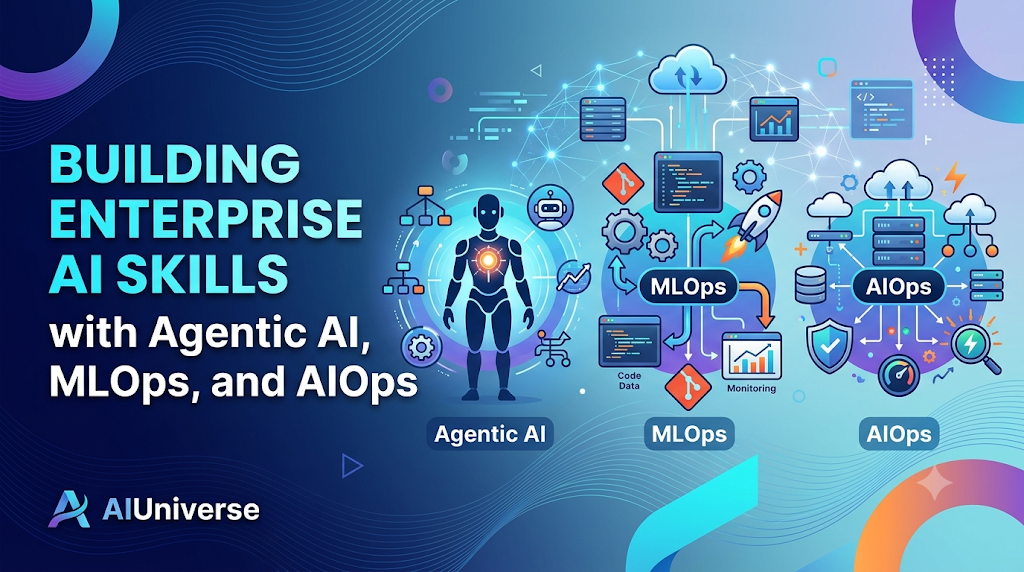
To bridge the gap between AI promise and enterprise-grade reality, three interconnected disciplines have emerged: Agentic AI, MLOps (Machine Learning Operations), and AIOps (Artificial Intelligence for IT Operations). Agentic AI shifts systems from passive responders to autonomous decision-makers. MLOps ensures these intelligence engines are deployed, monitored, and updated seamlessly. AIOps ensures the underlying infrastructure running these complex architectures remains performant, secure, and self-healing. Together, they form the cornerstone of modern enterprise transformation.
Understanding the Integrated AI Architecture
To understand how enterprise AI operates at scale, we must analyze how Agentic AI, MLOps, and AIOps interact across the modern software lifecycle. Rather than existing as isolated technology silos, these three domains form a continuous cycle of intelligence, deployment, and operational resilience.
       +-----------------------------------------------------------+
       |                        AGENTIC AI                         |
       |  (Autonomous Agents, Tool Calling, Planning, Reasoning)   |
       +-----------------------------+-----------------------------+
                                     |
                                     v
       +-----------------------------------------------------------+
       |                           MLOPS                           |
       | (Model Registry, LLMOps, Pipeline Orchestration, CI/CD)   |
       +-----------------------------+-----------------------------+
                                     |
                                     v
       +-----------------------------------------------------------+
       |                           AIOPS                           |
       | (Telemetry, Anomaly Detection, Incident Response, FinOps) |
       +-----------------------------------------------------------+
What is Agentic AI?
Agentic AI refers to systems built with autonomous agency. Unlike traditional conversational models that simply process input and generate text, AI agents plan, reason, use external tools, execute multi-step workflows, and evaluate their own outputs. An agentic system breaks down complex corporate objectives into distinct sub-tasks, calls external APIs, queries relational databases, interacts with software tools, and self-corrects when encountering errors.
What is MLOps and LLMOps?
Machine Learning Operations (MLOps) is the engineering discipline dedicated to standardizing and automating the machine learning lifecycle. It merges ML development with DevOps principles, covering data collection, feature engineering, model training, continuous integration/continuous deployment (CI/CD), model deployment, and real-time performance tracking. With the arrival of large language models, this field expanded into LLMOps, which focuses on prompt management, fine-tuning, vector database management, and guardrail enforcement.
What is AIOps?
Artificial Intelligence for IT Operations (AIOps) applies machine learning and big data analytics to modern IT infrastructure. As software environments become increasingly distributed across hybrid cloud and multi-cloud architectures, manual monitoring becomes impossible. AIOps platforms ingest vast volumes of telemetry data—logs, metrics, traces, and alerts—in real time to detect anomalies, correlate incidents, automate root cause analysis, and trigger self-healing remediation workflows.
Why Modern Organizations Need an Integrated Strategy
Deploying autonomous systems into core business operations without infrastructure and operational frameworks creates severe organizational bottlenecks. Enterprise IT environments demand stability, scalability, and strict compliance.
1. Scalability and Autonomous Execution
Traditional workflows rely on human intervention at almost every step. Agentic AI allows systems to make decisions and execute actions autonomously, dramatically accelerating operational velocity. However, running dozens or hundreds of autonomous agents requires scalable deployment pipelines managed by MLOps, as well as dynamic infrastructure scaling powered by AIOps.
2. Operational Cost Optimization (FinOps)
Large language models and high-performance computing clusters consume significant computational resources. Unmonitored LLM queries and unoptimized cloud deployments lead to unexpected costs. Implementing MLOps ensures efficient model quantization, caching, and model routing, while AIOps tracks resource utilization across cloud environments to prevent over-provisioning.
3. Governance, Security, and Risk Mitigation
Enterprise adoption of AI hinges on trust. Autonomous agents operating without oversight can introduce risks such as prompt injection attacks, sensitive data leaks, or uncoordinated database writes. Combining MLOps guardrails with AIOps security telemetry provides continuous monitoring, automated compliance checks, and full auditability across all operational environments.
Key Technical Concepts and System Architectures
Building production-ready AI systems requires mastering several structural patterns and technological frameworks across agents, deployment pipelines, and operational monitoring.
                  +-----------------------------------+
                  |        USER / ENTERPRISE APP      |
                  +-----------------+-----------------+
                                    |
                                    v
                  +-----------------------------------+
                  |       AGENT ORCHESTRATION         |
                  |     (LangGraph / AutoGen)         |
                  +--------+----------------+---------+
                           |                |
             +-------------+                +-------------+
             |                                            |
             v                                            v
+------------------------+                    +------------------------+
|    PROMPT / GUARDRAIL  |                    |    VECTOR DATABASE     |
|      (LangFuse/Braintrust)                  |  (Pinecone / Qdrant)   |
+------------+-----------+                    +-----------+------------+
             |                                            |
             +-------------+                +-------------+
                           |                |
                           v                v
                  +-----------------------------------+
                  |      MODEL / TOOL EXECUTION       |
                  |       (MLOps / Inference Hub)     |
                  +-----------------+-----------------+
                                    |
                                    v
                  +-----------------------------------+
                  |        AIOPS TELEMETRY            |
                  |      (Datadog / Dynatrace)        |
                  +-----------------------------------+
Agentic AI Architectures
Agentic systems move beyond basic prompt-response models by using complex orchestration frameworks:
- ReAct Pattern (Reasoning and Acting): The agent alternates between explicit reasoning steps (“Thought”) and external tool invocation (“Action”) to solve complex queries.
- Multi-Agent Orchestration: Specialized autonomous agents work together in teams. For example, a “Software Developer Agent” writes code, a “Code Reviewer Agent” inspects it for security bugs, and a “Deployment Agent” executes deployment scripts.
- Tool Calling & Memory: Agents interact with enterprise enterprise systems via REST APIs, GraphQL, and SQL database connectors while maintaining short-term context (conversation history) and long-term memory (vector index retrieval).
MLOps Pipelines and Continuous Delivery
An enterprise MLOps framework establishes reliable paths from experimental code to active production:
- Feature Stores & Vector DBs: Centralized repositories manage structured machine learning features (e.g., Feast) and unstructured vector embeddings (e.g., Pinecone, Qdrant, Milvus) for Retrieval-Augmented Generation (RAG).
- Prompt Management & Tracing: Tools track prompt versioning, optimize prompt templates, and record complete interaction traces to debug agent execution paths.
- Automated CI/CD: Automated pipelines run unit tests, evaluate model accuracy, verify safety guardrails, and manage blue-green or canary deployments.
AIOps Telemetry and Self-Healing Systems
AIOps shifts operations from reactive troubleshooting to proactive self-healing:
- Log and Metric Correlation: Natural language processing algorithms analyze billions of multi-cloud log lines to group related system alerts into single actionable incidents.
- Predictive Anomaly Detection: Machine learning baselines establish normal traffic and resource usage patterns, identifying anomalies long before hard failure thresholds are hit.
- Automated Remediation: When anomalies are detected, AIOps systems trigger automated runbooks to restart services, scale container clusters, or reroute network traffic.
Technical and Business Benefits
Adopting a unified enterprise AI strategy delivers clear advantages across both technology operations and business outcomes.
                               BUSINESS VALUE
                                     |
         +---------------------------+---------------------------+
         |                                                       |
         v                                                       v
TECHNICAL ADVANTAGES                                    BUSINESS IMPACT
- 99.99% Infrastructure Uptime                          - Faster Time-to-Market
- Automated Model Retraining                            - Reduced Operational Costs
- Deterministic Tool Execution                          - Improved Customer Satisfaction
- Scalable Vector Retrieval                             - Auditable Regulatory Compliance
Technical Benefits
- Reduced Mean Time to Resolution (MTTR): AIOps isolates the root cause of infrastructure failures in seconds rather than hours.
- Automated Lifecycle Management: MLOps eliminates manual model deployments, keeping prediction accuracy high through automated drift detection and retraining.
- Resilient Reasoning Workflows: Agentic framework guardrails prevent models from getting stuck in infinite loops or attempting unauthorized actions.
Business Benefits
- Accelerated Product Velocity: Standardized deployment platforms allow engineering teams to take AI products from prototype to production in days rather than months.
- Optimized Resource Allocation: Automated infrastructure scaling reduces cloud spend while ensuring optimal compute availability during peak usage periods.
- Regulatory Compliance and Audit Readiness: Comprehensive tracing and versioning across prompt pipelines and data workflows satisfy strict data protection regulations.
Enterprise Use Cases Across Key Industries
Organizations across diverse sectors use these frameworks to modernize core operations and launch innovative services.
+------------------+-------------------------------------------------------------+
| INDUSTRY         | AGENTIC AI + MLOPS + AIOPS ENTERPRISE APPLICATION           |
+------------------+-------------------------------------------------------------+
| Financial Services| Autonomous fraud detection, credit scoring, automated audit |
| Healthcare       | Clinical trial intelligence, diagnostic workflow pipelines   |
| Manufacturing    | Predictive maintenance, agentic supply chain routing        |
| Retail & Ecom    | Real-time dynamic pricing, automated customer service agents |
| Telecommunications| Autonomous network slice management, predictive outage fixes|
+------------------+-------------------------------------------------------------+
1. Financial Services and Banking
- Use Case: Autonomous Fraud Investigation and Risk Assessment.
- Implementation: Agentic AI systems continuously monitor transaction logs and gather supporting evidence from external databases. MLOps pipelines ensure fraud scoring models update dynamically based on changing fraud patterns, while AIOps platforms maintain strict high-availability uptime for real-time payment processing gateways.
2. Healthcare and Life Sciences
- Use Case: Clinical Trial Operations and Patient Data Analysis.
- Implementation: Multi-agent architectures aggregate and extract critical unstructured data from patient health records to streamline clinical trial matching. MLOps workflows enforce strict privacy and HIPAA-compliant data lineage, while AIOps monitors processing infrastructure to prevent system downtime.
3. Manufacturing and Supply Chain
- Use Case: Autonomous Supply Chain Optimization and Predictive Maintenance.
- Implementation: Specialized AI agents analyze global logistics updates, weather data, and warehouse inventories to automatically re-route shipments when disruptions occur. IoT sensor streams feed into MLOps models to predict equipment wear, while AIOps ensures edge computing nodes remain operational on factory floors.
4. Retail and E-commerce
- Use Case: Context-Aware Hyper-Personalization and Dynamic Inventory.
- Implementation: Conversational agents guide buyers through personalized catalog interactions using semantic search powered by vector databases. MLOps platforms manage real-time recommendation engines and dynamic pricing algorithms, while AIOps scales containerized e-commerce infrastructure during high-volume sales events.
Key Enterprise Challenges and How to Overcome Them
Despite the significant advantages, scaling these technologies within enterprise environments introduces distinct technical and operational hurdles.
       CHALLENGE                                SOLUTION
+-----------------------+              +-----------------------+
|  Siloed Teams         |  --------->  | Cross-functional pod  |
+-----------------------+              +-----------------------+
|  Model Drift & Bias   |  --------->  | Continuous MLOps      |
+-----------------------+              +-----------------------+
|  Uncontrolled Costs   |  --------->  | FinOps & AIOps rules  |
+-----------------------+              +-----------------------+
|  Skills Gap           |  --------->  | Targeted AI Training  |
+-----------------------+              +-----------------------+
1. Data Silos and Fragmented Architecture
Legacy infrastructure often segregates data across incompatible systems, making context retrieval difficult for AI agents.
- Solution: Implement unified data lakehouses, standardized API layers, and enterprise vector indexes to give models clean, secure access to company data.
2. Non-Deterministic Outputs and Hallucinations
Agentic frameworks can generate inaccurate outputs or attempt improper tool executions if unconstrained.
- Solution: Integrate deterministic guardrails, schema validation tools, human-in-the-loop validation steps, and comprehensive prompt management platforms.
3. Cultural Resistance and the Skills Gap
Engineering teams often lack practical expertise across modern LLMOps, vector index tuning, agent orchestration frameworks, and AIOps platforms.
- Solution: Invest in structured corporate training programs and continuous upskilling initiatives that bridge the gap between software engineering, cloud engineering, and data science disciplines.
Implementation Best Practices for Technology Leaders
Building enterprise-grade AI infrastructure requires disciplined execution across development, deployment, and governance.
- Adopt a Modular Component Architecture: Decouple your core AI logic from specific foundation model providers. Use model abstraction layers to swap underlying LLMs or local models as costs and capabilities evolve.
- Establish Shift-Left Safety and Security Monitoring: Test prompts, tool calls, and model outputs early in the continuous integration cycle. Apply strict input sanitization to block prompt injection techniques before inputs reach core models.
- Implement Full-Stack Telemetry: Combine application tracing (LLM latency, token usage, tool call success rates) with infrastructure telemetry (CPU/GPU utilization, memory saturation, network throughput) into unified operational dashboards.
- Standardize Centralized Governance: Maintain a centralized repository for prompts, fine-tuned models, vector indexes, and tool integration specifications to enforce security compliance across all business units.
Popular Tools and Technology Ecosystem
Navigating the enterprise AI landscape requires choosing the right software stack. Below is a breakdown of prominent commercial and open-source solutions driving modern implementations.
Prompt Management and Agent Orchestration
- LangChain & LangGraph: Powerful frameworks for building multi-agent workflows, stateful graphs, and complex reasoning pipelines.
- AutoGen: An open-source framework from Microsoft designed for creating collaborative, multi-agent systems.
- Langfuse / Braintrust: Specialized tools for prompt management, LLM tracing, evaluation, and observability.
MLOps and Model Management Platforms
- MLflow & Kubeflow: Industry-standard tools for tracking experiments, managing model registries, and orchestrating containerized machine learning pipelines.
- Weights & Biases: A comprehensive platform for tracking experiments, evaluating model outputs, and visualizing performance metrics.
- Feast: A widely used open-source feature store that manages real-time feature delivery for training and inference systems.
AIOps and Enterprise Monitoring Solutions
- Datadog & Dynatrace: Cloud-scale monitoring platforms that use machine learning to correlate telemetry, detect anomalies, and streamline root cause analysis.
- PagerDuty: An automated incident response platform that uses AIOps algorithms to group alerts and trigger automated remediation workflows.
- Splunk ITSI: An enterprise AIOps platform focused on event correlation, deep log analysis, and operational visibility.
Comparative Analysis: Architectural Frameworks and Approaches
Table 1: Feature Matrix Across Modern AI Operational Paradigms
| Technical Feature | Agentic AI Systems | MLOps / LLMOps Frameworks | AIOps Infrastructure |
|---|---|---|---|
| Primary Focus | Autonomous task execution & decision-making | Continuous delivery & model lifecycle management | Infrastructure resilience & telemetry analytics |
| Key Inputs | User prompts, API schemas, execution contexts | Training datasets, prompts, model code, hyper-parameters | Metrics, logs, network traces, system alerts |
| Core Outputs | Tool calls, multi-step actions, dynamic outputs | Versioned model artifacts, endpoints, evaluation scores | Automated alerts, incident analysis, self-healing actions |
| Primary Users | AI Engineers, Software Developers | Data Scientists, ML Engineers, MLOps Specialists | DevOps Engineers, SREs, Systems Administrators |
| Automation Level | Dynamic autonomy within configured constraints | Automated pipeline execution (CI/CD/CT) | Automated incident response and cluster scaling |
| Governance Role | Execution guardrails & tool authorization | Data provenance, prompt tracking & version control | Infrastructure security & access compliance |
Table 2: Traditional IT Operations vs. Agentic, MLOps, and AIOps Architecture
| Architectural Dimension | Traditional Enterprise IT Approach | Integrated AI Enterprise Approach |
|---|---|---|
| Workflow Execution | Deterministic scripts, static rules, human intervention | Autonomous reasoning agents with dynamic tool execution |
| Deployment Model | Periodic manual software updates and static deployments | Automated continuous training, prompt versioning, and canary rollouts |
| Monitoring Strategy | Static threshold alerts and reactive manual debugging | Predictive anomaly detection, token tracing, and correlated telemetry |
| System Scalability | Pre-allocated hardware compute and manual scaling | Dynamic, load-aware cloud infrastructure allocation |
| Incident Remediation | On-call engineers reviewing log files manually | Self-healing runbooks executing automated fixes in real time |
| Cost Management | Fixed capital expenses and static cloud budgeting | Real-time FinOps monitoring, token optimization, and usage-based scaling |
Career Opportunities and Industry Demand
The convergence of Agentic AI, MLOps, and AIOps has created strong market demand for skilled technical professionals. Organizations across industries are expanding their teams to design, build, and operate these complex systems.
                    EMERGING ENTERPRISE AI ROLES
                                 |
     +---------------------------+---------------------------+
     |                           |                           |
     v                           v                           v
AGENT ENGINE /           MLOPS / LLMOPS             AIOPS / SRE PLATFORM
DEVELOPMENT             ENGINEERING                  ENGINEERING
- LangGraph / AutoGen   - Pipeline Automation       - Telemetry Analytics
- Vector Indexing       - Model Registry & Guardrails- Self-Healing Workflows
- API Tool Integration  - Token Optimization        - Cloud Infrastructure
High-Demand Professional Roles
- Agentic AI Systems Engineer: Specializes in building autonomous agent architectures, multi-agent frameworks, tool-calling pipelines, and complex vector retrieval engines.
- MLOps / LLMOps Platform Engineer: Focuses on standardizing deployment pipelines, model registry infrastructure, fine-tuning setups, evaluation suites, and operational guardrails.
- AIOps & Observability Architect: Designs distributed telemetry ingestion networks, predictive anomaly detection platforms, and automated IT remediation workflows.
- Enterprise AI Solutions Architect: Oversees the end-to-end strategy, bridging the gap between business objectives, AI model capabilities, data security, and cloud infrastructure.
Essential Skills and Competencies
To excel in these roles, technical professionals need expertise across multiple domains:
- Programming & Frameworks: Python, TypeScript, LangChain, LangGraph, AutoGen, PyTorch.
- Cloud Infrastructure & Orchestration: Kubernetes, Docker, Terraform, AWS, Azure, Google Cloud Platform.
- Data & Observability Tools: Vector databases (Pinecone, Qdrant), Datadog, Prometheus, Grafana, MLflow, OpenTelemetry.
- Core Engineering Disciplines: CI/CD pipeline development, system design, REST/gRPC API integration, and security guardrail configuration.
Why Learn and Transform with AIUniverse
Mastering the modern AI ecosystem requires practical, hands-on experience with production-grade architectures. Theoretical knowledge alone is not enough when designing, deploying, and maintaining autonomous systems and operational pipelines.
                       THE AIUNIVERSE ECOSYSTEM
                                  |
     +----------------------------+----------------------------+
     |                            |                            |
     v                            v                            v
PRACTICAL EDUCATION         CORPORATE AI TRAINING          ENTERPRISE AI
  - Role-Based Learning       - Custom Team Upskilling       CONSULTING SERVICES
  - Hands-On Production Labs  - Architecture Modernization   - Strategic Roadmaps
  - Recognized Credentials    - Security & Governance        - End-to-End Execution
AIUniverse provides an integrated learning and advisory platform designed to help technical professionals and enterprise teams build real-world capability across modern AI domains:
- Role-Based Industry Certifications: Gain hands-on experience through structured programs like our Agentic AI certification course, MLOps certification course, and AIOps certification course. These programs focus on production-ready tools, real-world deployment patterns, and practical implementation scenarios.
- Comprehensive AI Learning Library: Explore an expansive curriculum offering AI certification courses online that cover LLMOps, vector indexing, prompt engineering, and cloud monitoring strategies.
- Custom Corporate Training: Empower technology teams with specialized Corporate AI training tailored to your company’s technology stack, architecture goals, and operational workflows.
- Enterprise Consulting Services: Accelerate digital transformation initiatives through AI consulting services, offering strategic advice on system design, technology evaluation, security frameworks, and custom solution deployments.
- Curated Tool and Resource Ecosystem: Gain insights into industry-leading tools and platforms, including evaluation guides for the Best prompt management tools, Federated learning platforms, Best MLOps tools, and the Best AI tools for business.
Whether you are an engineer looking to specialize in agentic architectures or a technology leader driving enterprise platform modernization, AIUniverse provides the educational resources, practical frameworks, and strategic guidance needed to build production-grade AI systems.
Frequently Asked Questions
1. What is the main difference between Agentic AI and traditional Machine Learning? Traditional Machine Learning focuses on static pattern recognition and predictions based on structured input data (such as predicting churn or classifying images). Agentic AI uses advanced language models and reasoning frameworks to break complex goals into sub-tasks, plan multi-step workflows, interact with external tools via APIs, and autonomously execute operations to achieve an objective.
2. How do MLOps and LLMOps differ from standard DevOps practices? While DevOps automates software code building, testing, and deployment, MLOps manages code, data, and machine learning models simultaneously. It handles non-deterministic outputs, data drift, and model retraining. LLMOps expands this to manage prompt templates, vector embeddings, fine-tuning workflows, safety guardrails, and token consumption costs.
3. What operational role does AIOps play in an enterprise AI deployment? AIOps applies machine learning and telemetry analytics to modern IT infrastructure. In enterprise AI setups, AIOps monitors cluster health, correlates system logs, detects resource bottlenecks, and triggers automated self-healing workflows. This ensures the underlying cloud infrastructure running your models and agents maintains high availability and low latency.
4. Why are vector databases critical for Agentic AI and MLOps platforms? Vector databases store mathematical embeddings of unstructured data (text, code, images, audio), allowing systems to perform fast similarity searches. They power Retrieval-Augmented Generation (RAG) by supplying relevant context to AI agents, acting as a long-term memory layer while minimizing hallucinations.
5. How does an enterprise prevent AI agents from taking unsafe or unintended actions? Enterprises enforce safety through multi-layered guardrail frameworks, strict API permissioning, deterministic validation schemas, and human-in-the-loop approvals for high-risk operations. Prompt tracing platforms monitor agent behavior in real time to detect and isolate unauthorized execution paths.
6. What are the key prerequisites for enrolling in an Agentic AI or MLOps certification course? Learners should have a solid foundation in Python programming, fundamental software engineering concepts, basic cloud service knowledge (AWS, Azure, or GCP), and familiarity with REST APIs. Prior experience with machine learning or DevOps is helpful but not strictly required.
7. How can organizations control cloud infrastructure costs when running large language models? Cost control requires effective MLOps and FinOps practices. Strategies include setting up semantic caching layers, quantizing fine-tuned models, using intelligent model routing (directing simple queries to smaller, lower-cost models), tracking token utilization, and using AIOps tools to auto-scale compute clusters based on actual demand.
8. Is AIOps intended to replace human DevOps engineers and System Administrators? No. AIOps is designed to augment human engineering teams by automating repetitive tasks, filtering out system noise, and reducing alert fatigue. By handling routine incident correlation and root-cause identification, AIOps allows SREs and system administrators to focus on high-value system design, security, and strategic platform improvements.
9. How do Agentic AI, MLOps, and AIOps work together in a unified production architecture? They form a complete operational ecosystem: Agentic AI acts as the intelligent user interface and reasoning layer; MLOps provides the CI/CD pipelines, model management, and performance tracking required to deploy those agents securely; and AIOps keeps the underlying cloud infrastructure operational, performant, and cost-effective.
Conclusion
The enterprise software landscape is evolving rapidly. Simple conversational interfaces and isolated machine learning experiments are giving way to autonomous agentic architectures, automated delivery pipelines, and self-healing infrastructure networks.
Organizations that successfully integrate Agentic AI, MLOps, and AIOps position themselves to build scalable, secure, and resilient systems capable of operating autonomously. By combining dynamic reasoning workflows, continuous model delivery, and proactive infrastructure monitoring, companies can unlock new levels of operational efficiency, speed up product innovation, and maintain a strong competitive edge.
Navigating this transition requires practical expertise, proven system designs, and a clear operational vision. Technology professionals and enterprise teams can partner with AIUniverse to access hands-on training programs, industry-recognized certifications, and strategic consulting services designed for modern, production-grade AI engineering.

