
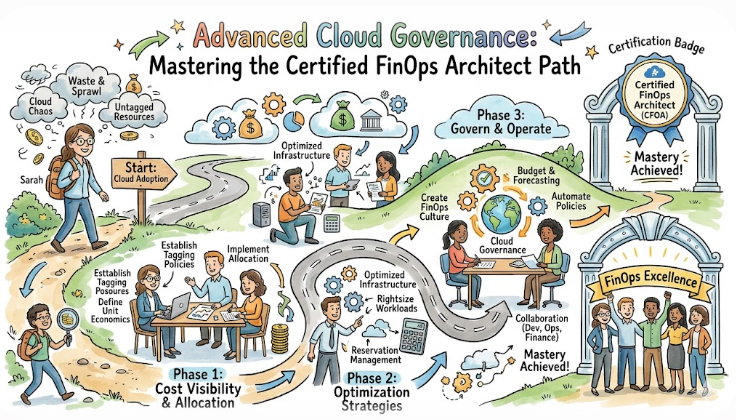
Navigating cloud environments requires a strategic balance between engineering speed and financial accountability. This guide is written for software engineers, systems administrators, cloud architects, and engineering managers who need to transition from passive cloud spending to active cloud financial management. As modern infrastructure becomes increasingly abstract, understanding cloud economics is no longer optional for senior professionals. This comprehensive blueprint helps technology leaders evaluate the Certified FinOps Architect program, understand its placement within corporate infrastructure teams, and determine how to maximize its career impact at FinOps School.
What is the Certified FinOps Architect?
The Certified FinOps Architect designation represents the highest tier of technical validation for cloud financial operations and architecture design. This program exists because standard cloud certifications focus almost entirely on availability and performance, frequently ignoring the cost implications of architectural choices. It bridges the gap between deep infrastructure engineering and corporate finance by teaching practitioners how to design systems that are inherently cost-optimized from day one. Instead of relying on passive, reactive cost-cutting measures, this certification validates your ability to build automated, unit-economic-driven cloud topologies.
Who Should Pursue Certified FinOps Architect?
This certification is designed for senior cloud professionals who hold architectural or operational responsibility for large-scale infrastructure environments. Site Reliability Engineers (SREs), DevOps architects, platform engineers, and principal developers will find immense value in aligning their technical designs with business metrics. It is equally critical for engineering managers, technology directors, and financial managers who need a deeply technical framework to govern enterprise-scale cloud deployments. Whether you are managing infrastructure within India’s booming technology hubs or leading global distributed engineering organizations, this curriculum addresses the critical need for financial accountability in complex engineering systems.
Why Certified FinOps Architect is Valuable Now and Beyond
In an industry where cloud platforms frequently update services, underlying core financial principles remain completely unchanged. The demand for professionals who can systematically eliminate cloud waste is growing rapidly as enterprises face tighter infrastructure budgets. Gaining expertise as an architect protects your career from changing tool trends by focusing on deep architectural design patterns, data analysis, and cross-functional governance. The return on investment for this certification manifests as immediate visibility within your organization, as you directly impact the bottom line while maintaining engineering velocity.
Certified FinOps Architect Certification Overview
The structured program is delivered via the Certified FinOps Architect and is hosted entirely on the main portal at FinOps School. This professional certification evaluates an engineer’s ability to implement culture changes, establish data-driven KPIs, and construct real-time visibility pipelines. Unlike entry-level exams that rely heavily on memorization, this evaluation framework tests deep structural logic, multi-cloud accounting mechanics, and complex organization-wide optimization strategies. It provides a formal validation process designed to prove you can lead a mature financial operations practice inside any modern enterprise.
Certified FinOps Architect Certification Tracks & Levels
The curriculum is structured across clear progressive tiers to support professionals at varying stages of their organizational journey. The foundational level focuses on establishing standard terminology, core structural pillars, and fundamental cloud cost allocation concepts. Moving into the professional track, the focus shifts toward advanced data engineering pipelines, unit economic modeling, and complex container orchestration cost management. The advanced architect tier demands full mastery over real-time automated remediation frameworks, global governance policies, and programmatic cloud commitment strategies.
Complete Certified FinOps Architect Certification Table
| Track | Level | Who it’s for | Prerequisites | Skills Covered | Recommended Order |
| Core Practices | Foundation | System Administrators, Junior Cloud Engineers | Basic Cloud Knowledge | Cost Allocation, Shared Costs, FinOps Lifecycle | Step 1 |
| Engineering | Professional | DevOps Engineers, SREs, Platform Teams | 2 Years Cloud Experience | Container Costing, Anomaly Detection, Automation | Step 2 |
| Architecture | Advanced | Principal Architects, Technical Directors | Professional Tier Knowledge | Unit Economics, Enterprise Governance, Commitment Portfolios | Step 3 |
Detailed Guide for Each Certified FinOps Architect Certification
Certified FinOps Architect – Foundation Level
What it is
This tier validates a professional’s foundational understanding of cloud financial frameworks, core metrics, and basic accountability models across public clouds.
Who should take it
This is designed for junior cloud engineers, procurement specialists, and software developers who need to understand the financial impacts of their day-to-day cloud operations.
Skills you’ll gain
- Identification of untagged resources and accurate cost allocation methodologies.
- Mastery of standard cloud billing terminology across major public cloud vendors.
- Ability to map cloud expenditures directly to specific business units and applications.
Real-world projects you should be able to do
- Construct an organization-wide resource tagging schema that maps 95% of cloud spend to specific engineering teams.
- Build a basic cost allocation dashboard that tracks monthly trends and isolates shared infrastructure expenses.
Preparation plan
- 7-14 Days: Review core architectural frameworks, read through foundational whitepapers, and memorize basic cloud financial terminology.
- 30 Days: Work through practical billing datasets, configure test billing alerts, and practice allocating shared costs across mock departments.
- 60 Days: Conduct full simulations of foundational exams, review missteps, and build custom tracking dashboards in a sandbox environment.
Common mistakes
- Underestimating the depth of organizational and cultural change metrics required on the exam.
- Focusing exclusively on one cloud vendor’s billing mechanics while neglecting multi-cloud scenarios.
Best next certification after this
- Same-track option: Certified FinOps Architect – Professional Level
- Cross-track option: DevSecOps Specialist Certification
- Leadership option: Certified Engineering Manager
Certified FinOps Architect – Professional Level
What it is
This level verifies an engineer’s capability to build operational pipelines, automate anomaly detection, and manage containerized infrastructure costs at scale.
Who should take it
This certification is optimized for active DevOps engineers, SREs, and systems architects responsible for production-grade Kubernetes clusters and automated CI/CD pipelines.
Skills you’ll gain
- Implementation of real-time cloud cost anomaly detection algorithms and alerting workflows.
- Advanced allocation of shared container resources using open-source calculation tooling.
- Designing automated infrastructure rightsizing workflows into active deployment pipelines.
Real-world projects you should be able to do
- Deploy an automated open-source cost tracking tool within a live multi-tenant Kubernetes cluster to allocate microservice costs accurately.
- Build a serverless remediation pipeline that flags and shuts down underutilized non-production resources automatically.
Preparation plan
- 7-14 Days: Deep dive into container cost allocation mechanisms and study programmatic api-driven billing data extraction methods.
- 30 Days: Build automated scripting routines to parse large billing files and implement anomaly detection scenarios in a lab environment.
- 60 Days: Practice end-to-end architectural implementation scenarios and take multiple comprehensive practice evaluations to confirm timing.
Common mistakes
- Failing to understand how container resource requests and limits translate directly to public cloud billing metrics.
- Relying too heavily on manual console adjustments rather than building infrastructure-as-code automation.
Best next certification after this
- Same-track option: Certified FinOps Architect – Advanced Level
- Cross-track option: Advanced Site Reliability Engineer
- Leadership option: Enterprise Infrastructure Director
Certified FinOps Architect – Advanced Level
What it is
This certification confirms complete mastery over enterprise-wide unit economic formulation, global cloud governance structures, and algorithmic commitment management.
Who should take it
This is built for principal engineers, cloud architects, and corporate technology leaders responsible for millions of dollars in annual public cloud expenditures.
Skills you’ll gain
- Formulation of complex unit economic metrics mapping cloud spend directly to business transactions.
- Design of automated, cross-cloud commitment portfolio management systems utilizing savings plans and reserved instances.
- Establishment of global corporate governance structures that enforce budget boundaries without slowing down deployment pipelines.
Real-world projects you should be able to do
- Architect a global, multi-cloud enterprise billing ledger that computes unit cost per active customer transaction across disparate systems.
- Design an algorithmic purchasing model for cloud commitments that maximizes coverage while minimizing the risk of unused reservation capacity.
Preparation plan
- 7-14 Days: Study advanced financial forecasting math models and analyze corporate governance case studies.
- 30 Days: Build simulated unit economic mathematical models using complex infrastructure data inputs from multi-cloud deployments.
- 60 Days: Perform comprehensive architecture design reviews based on real-world case studies to prepare for advanced scenario evaluations.
Common mistakes
- Focusing too much on basic infrastructure rightsizing instead of designing systemic business unit metrics.
- Ignoring the cultural negotiation strategies required to align executive financial officers with engineering leadership teams.
Best next certification after this
- Same-track option: Executive Cloud Strategy Masterclass
- Cross-track option: Principal Platform Architect
- Leadership option: Chief Technology Officer Certification
Choose Your Learning Path
DevOps Path
This path embeds financial intelligence directly into your continuous integration and continuous deployment pipelines. Engineers learn how to include cost estimation metrics as part of their standard pull request evaluation cycles. This ensures that infrastructure changes are fully analyzed for cost impact before code is ever merged into production branches. Over time, this practice creates an automated guardrail system that prevents expensive deployment accidents.
DevSecOps Path
This trajectory integrates cloud financial accountability with security compliance and vulnerability management frameworks. Practitioners treat cloud cost anomalies exactly like security vulnerabilities, assigning risk scores to financial waste patterns. It focuses on using cloud policy engines to enforce budget restrictions alongside standard security compliance configurations. This path ensures that security controls do not inadvertently create unoptimized, bloated cloud architectures.
SRE Path
This methodology treats financial efficiency as a core system reliability metric alongside availability, latency, and performance. SREs learn to configure custom cost-based Service Level Indicators and Service Level Objectives for distributed cloud applications. This approach balances traditional infrastructure performance metrics with the financial cost of running highly redundant systems. The ultimate goal is minimizing operational spend while maintaining strict system availability targets.
AIOps Path
This specialty applies machine learning models to large-scale infrastructure billing telemetry and operational data. Engineers focus on building predictive forecasting models that anticipate cloud spending spikes based on historical application usage. It covers the deployment of automated, algorithmically driven remediation routines that optimize multi-cloud infrastructure dynamically. This path eliminates manual tracking by delegating routine optimization patterns to automated software agents.
MLOps Path
This path tackles the unique and volatile infrastructure costs associated with machine learning model training and inference pipelines. Machine learning engineers learn how to optimize expensive GPU cluster usage, data storage tiers, and model deployment topologies. It focuses heavily on calculating the precise return on investment for complex data science experiments running at scale. This ensures that massive training operations are executed efficiently without causing unexpected budget overruns.
DataOps Path
This specific framework addresses the financial governance challenges of enterprise data warehouses, massive data lakes, and streaming pipelines. Data specialists learn how to monitor query efficiency, manage partition strategies, and automate lifecycle rules for petabyte-scale storage. It provides practical strategies for identifying and refactoring poorly written database queries that generate massive on-demand bills. This path creates a culture of cost-conscious data engineering across all corporate data repositories.
FinOps Path
The direct specialized path centers entirely on maximizing business value by orchestrating collaboration between finance, engineering, and business units. Practitioners focus deeply on cultural transformations, cost allocation accuracy, forecasting methodologies, and centralized commitment optimization. It provides the complete framework needed to build a fully functional cloud financial center of excellence from scratch within an organization. This path transforms technology setups from an uncontrollable corporate expense into a predictable driver of business growth.
Role → Recommended Certified FinOps Architect Certifications
| Role | Recommended Certifications |
| DevOps Engineer | Foundation Level, Professional Level |
| SRE | Foundation Level, Professional Level |
| Platform Engineer | Professional Level, Advanced Level |
| Cloud Engineer | Foundation Level, Professional Level |
| Security Engineer | Foundation Level, Professional Level |
| Data Engineer | Foundation Level, Professional Level |
| FinOps Practitioner | Foundation Level, Professional Level, Advanced Level |
| Engineering Manager | Foundation Level, Advanced Level |
Next Certifications to Take After Certified FinOps Architect
Same Track Progression
Once you complete the advanced level, your progression should focus on deep global enterprise business alignment strategies. This involves moving toward executive certifications that focus heavily on long-term corporate mergers, global regulatory compliance, and multi-year cloud procurement negotiations. The technical focus shifts away from individual pipelines toward governing massive, disparate infrastructure portfolios distributed across thousands of organizational accounts.
Cross-Track Expansion
To build a highly resilient career, couple your architectural financial expertise with advanced certifications in platform engineering or site reliability engineering. Understanding how to build self-service internal developer platforms that automatically include cost guardrails makes you incredibly valuable to enterprise employers. This cross-functional expansion proves you can write clean, scalable infrastructure code while keeping organizational systems running smoothly and cost-effectively.
Leadership & Management Track
For senior engineers aiming to transition entirely into executive management, pairing financial architecture validation with formal engineering leadership certifications is ideal. This educational evolution prepares you to speak both the language of deep system architecture and corporate boardroom financial planning. It qualifies you to step comfortably into roles like Director of Infrastructure, Vice President of Engineering, or Chief Technology Officer.
Training & Certification Support Providers for Certified FinOps Architect
DevOpsSchool provides comprehensive instructor-led training formats that focus heavily on combining core continuous integration practices with modern cloud financial optimization principles for engineering teams.
Cotocus delivers deeply practical, lab-driven educational bootcamps designed to give systems administrators and engineers hands-on experience navigating complex multi-cloud billing datasets safely.
Scmgalaxy offers an extensive repository of technical articles, community forums, and blueprint guides focusing on integrating infrastructure-as-code routines with automated cost optimization guardrails.
BestDevOps focuses on delivering high-quality training modules centered on modern platform engineering workflows, real-time tracking setups, and enterprise infrastructure design strategies.
devsecopsschool specializes in helping security-focused engineers integrate financial anomaly detection policies directly into existing automated continuous security compliance pipelines.
sreschool provides targeted educational tracks that treat cloud cost metrics as an essential pillar of production system reliability and service level objective management.
aiopsschool teaches engineering professionals how to utilize advanced machine learning frameworks to automate cloud cost anomaly analysis and predictive infrastructure forecasting models.
dataopsschool focuses exclusively on delivering specialized training patterns aimed at managing and optimizing the massive infrastructure costs associated with enterprise big data warehouses.
finopsschool serves as the primary specialized education provider for this architecture track, delivering complete end-to-end certification pathways covering foundational concepts up to advanced enterprise mastery.
Frequently Asked Questions (General)
- What is the primary objective of this architecture certification program?
The core goal is validating an individual’s ability to design, implement, and govern cloud infrastructure setups that balance engineering velocity with strict financial optimization and business value. - How long does it typically take to complete the preparation process?
Depending on your existing cloud engineering experience, preparation times vary from 30 days for foundational tracks to over 90 days for advanced enterprise architectural evaluations. - Are there strict technical prerequisites required before attempting the exams?
While the foundational tier requires only general cloud familiarity, the professional and advanced levels demand a solid understanding of system architectures, containerization, and deployment automation. - What makes this certification path distinct from standard cloud provider credentials?
Standard vendor certifications focus almost entirely on operational availability and feature implementation, while this path evaluates your structural ability to optimize those configurations financially. - Does the curriculum cover multi-cloud environments or focus on one vendor?
The framework is fully vendor-agnostic and teaches architectural principles, data calculation strategies, and governance policies applicable across AWS, Azure, Google Cloud, and private setups. - How does completing this certification path impact an engineer’s career path?
It elevates your professional standing from a pure infrastructure engineer to a strategic corporate asset capable of aligning technical execution directly with company profit metrics. - Is there a practical, hands-on lab component required during the testing phase?
Yes, the professional and advanced validation tiers require candidates to resolve architectural optimization scenarios and analyze complex billing data models. - How frequently are the certification curriculum and exam contents updated?
The program materials are revised continuously to keep pace with evolving cloud cost management tooling, container orchestration patterns, and industry governance practices. - Can non-engineering professionals benefit from pursuing this certification track?
Yes, financial analysts, procurement officers, and product managers can complete the foundational tier to collaborate effectively with technical infrastructure teams. - What type of organizations derive the most value from employing certified architects?
Any enterprise running large-scale cloud operations, migrating legacy systems, or navigating complex containerized environments will see immediate benefits from this structural expertise. - Does this certification focus on manual cost-cutting or automated remediation?
The primary focus is on building sustainable engineering automation, continuous policy enforcement, and infrastructure-as-code configurations that handle cost optimization programmatically. - How can I maintain my certified status after passing the formal evaluations?
Maintaining your active status requires participating in continuing education courses, engaging with the professional community, or upgrading to the next progressive certification tier.
FAQs on Certified FinOps Architect
- How does the Certified FinOps Architect credential directly address modern container costs?
The program provides specific architectural blueprints for breaking down shared Kubernetes cluster expenses, mapping resource usage to specific deployments, and implementing automated pod autoscaling configurations based on cost metrics. - What specific financial reporting methodologies are evaluated during the architecture exams?Candidates must demonstrate deep mastery over calculating unit economics, creating accurate cost amortizations, allocating untagged resource expenses, and designing forecasting algorithms for multi-cloud deployments.
- Can this certification help our engineering team reduce cloud waste without dropping performance?
Absolutely, because the entire framework focuses on rightsizing infrastructure configurations, configuring intelligent storage tiering policies, and choosing the exact payment models that preserve system reliability. - How do enterprise organizations leverage this certification to build internal cloud centers of excellence?
This certification acts as the educational blueprint for standardizing operational terms, setting corporate governance rules, and building cross-functional teams that unite finance and engineering. - What specific scripting and automation skills are required to pass the professional level?Practitioners should be comfortable using infrastructure-as-code tools to deploy cost controls and writing automated routines to extract data from public cloud billing APIs.
- How does the curriculum handle complex commitment portfolios like Savings Plans and Reserved Instances?
The advanced modules train architects to analyze historical usage data, calculate risk portfolios, and buy cross-cloud commitment structures that maximize cost savings. - Why should a team leader prioritize this certification over standard agile or management credentials?
This program provides a deeply technical framework tailored specifically for managing cloud budgets, giving managers the precise metrics needed to evaluate infrastructure efficiency. - What real-world data analysis tools are candidates expected to master during the course?
The training covers using open-source visualization platforms, cloud-native billing tools, and automated SQL engines to run complex queries against massive corporate infrastructure datasets.
Final Thoughts: Is Certified FinOps Architect Worth It?
Investing time and effort into the Certified FinOps Architect program is a highly practical decision for cloud professionals who want to move beyond routine system maintenance. The industry has reached a point where building operational systems without considering their financial impact is no longer sustainable. Organizations need engineers who can write highly resilient code while understanding how those systems affect the corporate bottom line.
Earning this credential moves you past simple tool-specific configurations and establishes you as a strategic asset who understands how to scale systems efficiently. If you want to elevate your career, gain deep architectural visibility, and lead major enterprise cloud strategies, this educational path provides the clear, real-world framework you need to succeed.

