
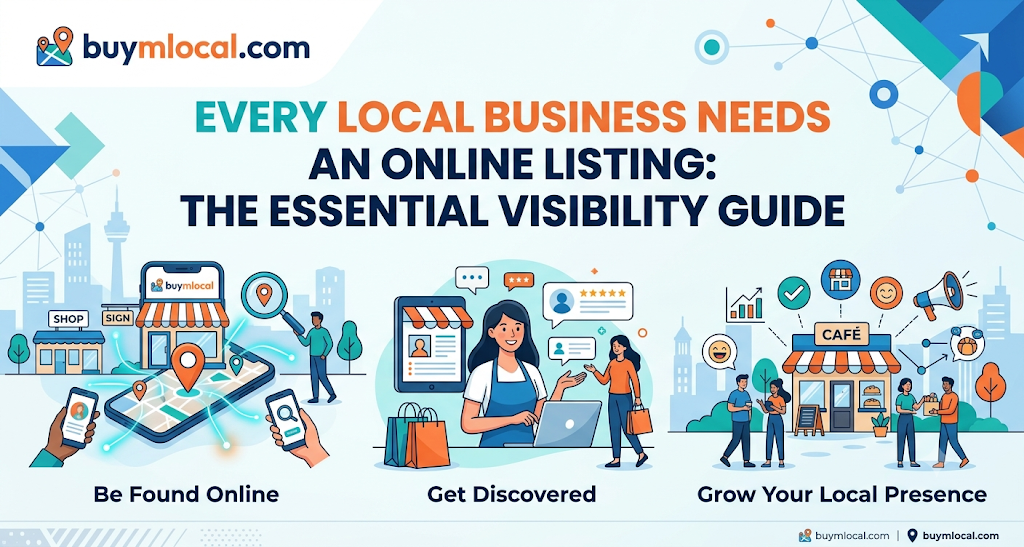
Introduction: The Digital Shift in Local Discovery
For decades, neighborhood businesses relied on physical foot traffic, storefront signage, print directories, and word-of-mouth recommendations to sustain their customer base. While community reputation remains vital, consumer buying behavior has fundamentally changed. Today, the customer journey begins with an online search on a smartphone.
Whether a homeowner searches for an emergency plumber, a professional looks for a quiet coffee shop, or a shopper seeks specialty hardware, consumers turn to digital directories and search engines before visiting a physical location. When your company lacks an up-to-date online listing for local businesses, your business becomes invisible to prospective buyers actively looking for your services in your immediate area.
Relying solely on drive-by visibility or social media leaves significant revenue on the table. An online business listing acts as a permanent, searchable digital anchor that provides verified operational details, establishes consumer trust, and connects nearby demand with your physical storefront.
This guide explains what an online business listing is, why it serves as the cornerstone of local business visibility, how it powers local SEO, and how local discovery platforms help small businesses compete effectively in their local markets.
What Is an Online Business Listing?
An online business listing (also known as a local citation or directory profile) is a public digital record of a business’s core operational information published on an online directory, search platform, mapping service, or discovery hub.
┌─────────────────────────────────────────────────────────────┐
│                 ANATOMY OF AN ONLINE LISTING                │
└────────────────────────────┬────────────────────────────┘
                             │
  ┌──────────────────────────┼──────────────────────────┐
  ▼                          ▼                          ▼
[CORE NAP DATA]       [OPERATIONAL DETAILS]     [TRUST SIGNALS]
• Business Name       • Opening Hours           • Verified Customer Reviews
• Physical Address    • Product & Service Menu  • Real Storefront Photos
• Phone Number        • Website & Map Links     • Official Category Tags
Unlike traditional print advertisements or static billboards that expire when campaign budgets end, an online listing functions as an ongoing digital asset. It provides structured data that search engine crawlers and consumers use to verify that a business is legitimate, open, and located where it claims to be.
Key Details Included in an Online Listing:
- NAP Data: Exact business Name, physical Address, and working Phone number.
- Operating Schedule: Standard operating hours, holiday closures, and seasonal schedules.
- Category Tagging: Primary and secondary business classifications (e.g., “Italian Restaurant,” “Commercial HVAC Contractor”).
- Service Offerings: Detailed itemizations of products, capabilities, or service packages.
- Rich Media: High-resolution storefront photography, interior images, team photos, and menus.
- Interactive Elements: Direct website hyperlinks, click-to-call buttons, driving directions, and customer review modules.
Why Online Visibility Matters for Local Businesses
Local commerce has shifted toward a digital-first model. Consumers now research online even when planning an offline, in-person purchase:
- Dominance of Mobile Search: Mobile users frequently conduct local searches with high purchase intent (such as “hardware store near me” or “auto repair open now”). These queries often lead to a phone call, message, or store visit within 24 hours.
- Zero-Friction Decision Making: Modern buyers compare local alternatives within seconds. If your operating hours, address, or service menus are missing online, consumers will immediately choose a competitor whose listing provides clear answers.
- Leveling the Playing Field: Well-optimized local listings allow independent shops and service providers to outrank larger national chains in map-pack results for hyper-local queries.
Why Every Local Business Needs an Online Listing
Securing verified listings across prominent business directories delivers major operational and commercial benefits:
┌─────────────────────────────────────────────────────────────┐
│                 WHY LOCAL LISTINGS MATTER                   │
├──────────────────────────────┬──────────────────────────────┤
│  • Instant Local Discovery   │  • Higher Search Rankings    │
│  • Verified Consumer Trust   │  • Around-the-Clock Inquiries│
│  • Accurate Contact Details  │  • Authentic Customer Proof  │
└──────────────────────────────┴──────────────────────────────┘
- Captures High-Intent Local Traffic: Connects your business with customers at the exact moment they are looking to buy.
- Establishes Immediate Credibility: A complete profile featuring customer reviews, clear photos, and accurate hours signals that your business is active, professional, and reliable.
- Prevents Customer Confusion: Keeping your address, suite number, and phone number updated across platforms ensures customers arrive at the right location without frustration.
- Maintains a 24/7 Digital Storefront: Even when your physical doors are closed, an online listing displays your services, answers basic questions, and accepts quote requests around the clock.
How Online Listings Help Customers Make Buying Decisions
A local business listing helps remove friction throughout the entire customer journey:
┌─────────────────┐       ┌─────────────────┐       ┌─────────────────┐
│ LOCAL DISCOVERY │ ────► │ TRUST VALIDATION│ ────► │ DIRECT ACTION   │
│ Customer finds  │       │ Checks reviews, │       │ Calls, gets map │
│ listing online  │       │ photos & hours  │       │ routes, or visits│
└─────────────────┘       └─────────────────┘       └─────────────────┘
- Discovery: The customer identifies nearby providers that match their specific need.
- Evaluation: The customer reviews opening hours, checks photos to gauge atmosphere or product selection, and reads recent customer ratings.
- Action: The customer clicks for driving directions, taps the phone number to call directly, or visits your website to book an appointment.
Online Listings and Local SEO: How Discovery Works
A local business listing is one of the most important ranking factors in local SEO. Search engine algorithms rely on directory citations to understand your business’s relevance and authority:
- NAP Consistency: Search engines cross-reference your Name, Address, and Phone number across directory platforms. Consistent data builds algorithmic trust, while conflicting addresses or phone numbers dilute your ranking strength.
- Relevance and Categorization: Selecting the precise primary and secondary categories helps search engines match your profile to specific customer queries.
- Review Signals: The quantity, recency, and average rating of customer reviews directly influence your placement in local map packs.
- Proximity Matching: Search algorithms balance the searcher’s physical location with your verified address to deliver the most geographically relevant results.
Side-by-Side Comparison Tables
Business With Online Listing vs. Business Without Online Listing
| Operational Factor | Business With an Online Listing | Business Without an Online Listing |
| Local Discoverability | Appears in map searches, directories, and “near me” queries | Relies entirely on foot traffic and existing word-of-mouth |
| Customer Information | Accurate hours, address, phone, and services accessible instantly | Customers struggle to verify if the business is open or exists |
| Consumer Trust | High; validated by authentic reviews, photos, and verified badges | Low; absence of online verification creates buyer hesitation |
| Search Visibility | Ranks in localized search engine results and map packs | Completely absent from modern local search engine indexes |
| Customer Inquiries | Receives automated click-to-call inquiries and map direction requests | Misses digital inbound leads to visible competitors |
| Competitive Advantage | Actively captures nearby market share across digital touchpoints | Loses market share to competitors with complete profiles |
Online Listing vs. Social Media Profile
| Feature / Attribute | Online Business Listing | Social Media Business Page |
| Primary Purpose | Structured directory discovery and local search indexing | Community engagement, content sharing, and brand updates |
| Search Discoverability | Optimized for search engines, map packs, and directory searches | Limited search visibility; primarily discovered within the app |
| Customer Intent | High purchase intent; users actively seeking immediate solutions | Browsing intent; users consuming entertainment or social feeds |
| Information Layout | Standardized, scannable operational details (hours, address, phone) | Chronological feeds where basic details can get lost |
| Best Strategic Role | Core foundation for local business visibility and inbound calls | Nurturing existing relationships and sharing special announcements |
Key Benefits of an Online Listing for Local Businesses
┌─────────────────────────────────────────────────────────────┐
│                 BENEFIT IMPACT BREAKDOWN                    │
├──────────────────────────────┬──────────────────────────────┤
│ CUSTOMER IMPACT              │ BUSINESS IMPACT              │
│ • Clear driving directions   │ • Higher conversion rates    │
│ • Verified operating hours   │ • Scalable local discovery   │
│ • Transparent service pricing│ • Lower marketing costs      │
│ • Direct call/booking access │ • Stronger market reputation │
└──────────────────────────────┴──────────────────────────────┘
1. Improved Local Discoverability
A verified listing makes your business visible to nearby consumers at the exact moment they need your products or services, expanding your reach beyond standard foot traffic.
2. Verified Consumer Credibility
Modern buyers hesitate to engage with businesses that lack an online presence. An active listing with verified customer reviews, transparent pricing, and clear photos provides immediate social proof.
3. Clear and Consistent Communication
By displaying accurate operating hours, emergency contact lines, and holiday schedules, you eliminate customer frustration caused by unannounced closures or incorrect phone numbers.
4. Stronger Foundation for Local SEO
Directory listings act as digital citations that help search engine algorithms confirm your business’s physical location and legitimacy, improving your organic map-pack rankings.
5. Centralized Review Gathering
Listings provide a public platform for satisfied clients to share their experiences, creating a repository of authentic reviews that continually attracts new customers.
How Different Local Businesses Benefit in Practice
Online listings support diverse business models across every sector of the local economy:
- Restaurants, Cafes & Bakeries: Showcase digital menus, highlight dietary options, display daily hours, and provide one-click driving directions to diners looking for nearby meals.
- Home Service Providers (Plumbers, Electricians, HVAC): Display specific service territories, emergency dispatch availability, and licensing credentials to capture urgent local repair calls.
- Specialty Retailers & Boutique Shops: Highlight unique inventory, artisan goods, and neighborhood locations, allowing shoppers to confirm product availability before visiting.
- Healthcare & Wellness Clinics: Share provider credentials, accepted insurance plans, office hours, and booking links, making it easy for patients to schedule consultations.
- Professional & B2B Services (Accountants, Legal Advisors): Highlight practice areas, client case studies, and office locations to build authority and win local corporate retainers.
How to Create an Effective Online Business Listing
Creating a high-performing business listing requires a systematic approach to ensure your profile is complete, accurate, and optimized for search discovery:
[Phase 1: Foundation]   ──► Step 1: Input Exact Legal Business Name
                        ──► Step 2: Select Primary & Secondary Categories
                        ──► Step 3: Enter Standardized Address & Phone (NAP)

[Phase 2: Details]      ──► Step 4: Define Accurate Operating Hours
                        ──► Step 5: Write an Informative Business Description
                        ──► Step 6: Upload High-Resolution Storefront Media

[Phase 3: Engagement]   ──► Step 7: Systematically Collect Customer Reviews
                        ──► Step 8: Update Seasonal Hours & Audit Citations
Step 1: Use an Exact, Consistent Business Name
Use your real, registered business name without adding artificial keywords or slogans. Adding unnecessary keywords can violate directory guidelines and confuse customers.
Step 2: Select the Most Specific Business Categories
Choose primary and secondary categories that accurately describe your core offerings. Accurate categories ensure search engines match your listing with relevant customer searches.
Step 3: Standardize Your Address and Phone Details
Ensure your address format (including suite numbers, street abbreviations, and zip codes) and phone number match your website footer and official records exactly.
Step 4: Publish Accurate Operating Hours
Clearly display your standard weekly hours, and update them promptly for holidays or seasonal schedule changes to prevent customer confusion.
Step 5: Write an Informative, Reader-Focused Description
Summarize what your business does, the specific problems you solve, and what sets your offerings apart, integrating relevant local keywords naturally.
Step 6: Upload High-Resolution Photos
Add clear, authentic photos of your storefront exterior, interior workspace, product displays, and staff. Real photography builds significantly more trust than generic stock photos.
Step 7: Actively Encourage and Respond to Reviews
Set up a simple post-service follow-up process to ask happy customers for honest feedback. Always respond professionally to both positive and negative reviews.
Step 8: Keep Your Information Updated
Review your directory profiles regularly to ensure all phone numbers, menu links, service lists, and business hours remain accurate as your business evolves.
Common Online Listing Mistakes Local Businesses Must Avoid
- Inconsistent NAP Data: Using different phone numbers or addresses across various directories confuses search engines and hurts local search visibility.
- Choosing Incorrect Business Categories: Selecting vague or inaccurate categories prevents your listing from surfacing for relevant local queries.
- Leaving Business Details Incomplete: Leaving descriptions, menus, or photos blank signals to both algorithms and customers that the profile is abandoned.
- Ignoring Customer Reviews: Failing to respond to customer feedback—especially critical reviews—damages consumer trust and reduces conversion rates.
- Creating Duplicate Listings: Having multiple conflicting listings for the same business splits your review equity and confuses search engines.
- Failing to Update Holiday Schedules: Forgetting to update your profile during holidays leads to frustrated customers arriving at closed storefronts.
How BuyMLocal.com Helps Customers Discover Local Businesses
While broad search engines handle general search traffic, dedicated local platforms play an important role in connecting consumers directly with neighborhood shops and services.
┌─────────────────────────────────────────────────────────────┐
│                      BUYMLOCAL.COM PLATFORM                 │
│              Local Discovery & Business Visibility          │
└──────────────────────────────┬──────────────────────────────┘
                               │
     ┌─────────────────────────┼─────────────────────────┐
     ▼                         ▼                         ▼
[LOCAL SHOP DISCOVERY]   [NEIGHBORHOOD ACCESS]   [PRODUCT PROFILES]
• Categorized listings   • Connects buyers with  • Highlights local
• Search by location     • local storefronts     • services and goods
• Builds digital presence• Promotes local buying • Verified contact info
BuyMLocal.com serves as a local business discovery platform designed to help businesses establish an online presence and connect with nearby customers:
- Improving Local Business Visibility: Provides a dedicated platform where small shops, independent artisans, and local service providers can be discovered by consumers searching within their area.
- Connecting Nearby Shoppers with Storefronts: Helps bridge the gap between consumers who prefer to support neighborhood businesses and the local shops that serve them.
- Showcasing Local Products and Services: Allows businesses to list their core offerings, contact details, and location information in a clean, easily accessible directory profile.
- Building a Sustainable Digital Presence: Gives growing businesses an additional digital channel to build authority, capture local inquiries, and expand community reach.
By maintaining a presence on discovery platforms like BuyMLocal.com, business owners create another reliable channel for local customers to discover their services.
The Online Listing Verification Checklist
Use this checklist to audit your local directory profiles and ensure all operational information is complete and accurate:
Markdown
### Local Business Online Listing Checklist

#### 1. Core Profile Information
- [ ] Registered business name is accurate and free of keyword stuffing.
- [ ] Primary business category accurately reflects your main service.
- [ ] Secondary categories added to cover additional specializations.
- [ ] Physical street address and suite numbers are verified and standardized.
- [ ] Primary local phone number is active and connected to a monitored line.

#### 2. Operational Details
- [ ] Regular weekly opening and closing hours are clearly displayed.
- [ ] Special holiday and seasonal schedules are updated.
- [ ] Website URL points directly to an active, secure (HTTPS) landing page.
- [ ] Service area boundaries are defined for mobile and on-site businesses.

#### 3. Visuals & Content
- [ ] Clear, high-resolution exterior storefront photo uploaded.
- [ ] Interior ambiance, product displays, or workspace photos included.
- [ ] Informative business description explains core offerings and values.
- [ ] Comprehensive list of services or products added to the profile.

#### 4. Reputation & Maintenance
- [ ] Systematic review-request process set up for completed jobs.
- [ ] Professional owner responses posted to all existing reviews.
- [ ] Duplicate or outdated listings identified and removed.
- [ ] Monthly listing audit scheduled to keep all information current.
Frequently Asked Questions (FAQs)
What is an online business listing?
An online business listing is a public digital profile on a directory, search platform, or mapping service that displays a business’s core information, including its name, address, phone number, hours, services, and customer reviews.
Why does my local business need an online listing if I already have a website?
While your website serves as your owned digital home, online listings act as digital entry points across search engines, maps, and directories. They help search engines verify your physical location and allow customers to find your contact details quickly without browsing your entire site.
How do online listings help improve local SEO?
Directory listings provide search engines with consistent business citations (Name, Address, Phone number). When this data matches across multiple trusted platforms, search algorithms gain confidence in your business’s legitimacy and rank your site higher in local map-pack results.
What core information should every business listing include?
Every listing should include your exact business name, physical street address, local phone number, standard operating hours, website link, primary business category, an informative description, and high-quality storefront photos.
Are online business listings useful for businesses without a physical storefront?
Yes. Service-area businesses (such as mobile mechanics, electricians, and home cleaners) can set up listings that highlight the specific cities or postal codes they serve while keeping their residential address private.
How do customer reviews on listings impact my business?
Reviews provide authentic social proof that influences prospective buyers. They also serve as an important ranking signal for local search algorithms, with higher review counts and positive ratings driving better visibility.
How often should I update my online business listings?
You should audit your primary listings at least once a month. Update your operating hours immediately whenever schedules change for holidays, renovations, or seasonal shifts.
What is the most common mistake businesses make with online listings?
The most common mistake is allowing inconsistent business information (NAP discrepancies) across different platforms, such as having an old phone number or an outdated suite address on secondary directory sites.
Is an online listing better than having a social media page?
Both tools serve different purposes. Online listings are optimized for high-intent search discovery when customers are ready to buy, while social media pages focus on ongoing engagement and brand updates. Using both provides the strongest overall digital presence.
How does BuyMLocal.com help local businesses?
BuyMLocal.com provides a community-focused discovery platform where small businesses can list their services, showcase their products, improve local visibility, and connect directly with nearby customers looking to support local shops.
Conclusion: Taking Control of Your Local Presence
In an increasingly digital marketplace, an online listing for local businesses is no longer optional—it is a fundamental requirement for staying competitive. While traditional word-of-mouth remains valuable, modern consumers rely on search engines, digital maps, and local discovery directories to find, evaluate, and choose neighborhood businesses.
An accurate, complete business listing builds immediate consumer trust, provides search engines with verified location data, and turns local search queries into phone calls, foot traffic, and sales.
By claiming your directory profiles, keeping your business details consistent, gathering authentic customer reviews, and listing your business on community discovery platforms like BuyMLocal.com, you ensure your company remains visible and accessible to nearby customers—building a solid foundation for sustainable local growth.

