Introduction: The Hidden Numbers Behind Cellular Connections
Every time a mobile phone connects to a cellular tower, a silent digital handshake takes place. The device does not simply look for a familiar commercial brand name. Instead, it reads a sequence of radio signals broadcast into the air. These signals contain precise numerical identifiers established by international telecommunications standards. Within milliseconds, the phone decodes these numbers to determine whether it has found its home network, a valid roaming partner, or a restricted carrier.
For telecommunications professionals, software developers, and connectivity researchers, these numbers are far more than background technical data. They serve as the core addressing system of global cellular communications. Understanding who owns an identifier, which territory it serves, and whether it represents physical infrastructure or a virtual arrangement is essential for building telecom software, configuring international roaming, managing Internet of Things (IoT) deployments, and analyzing market competition.
Investigating these numbers requires reliable reference data. Running an MCC MNC Lookup allows engineers and analysts to identify the exact regulatory assignment tied to a specific network code, separating consumer marketing from the legal and technical reality of the network. Platforms like eSIMGlobo are built to assist in this process, organizing public telecom assignments, network operator identities, and verification histories into an accessible reference directory.
What Mobile Network Identifiers Actually Represent
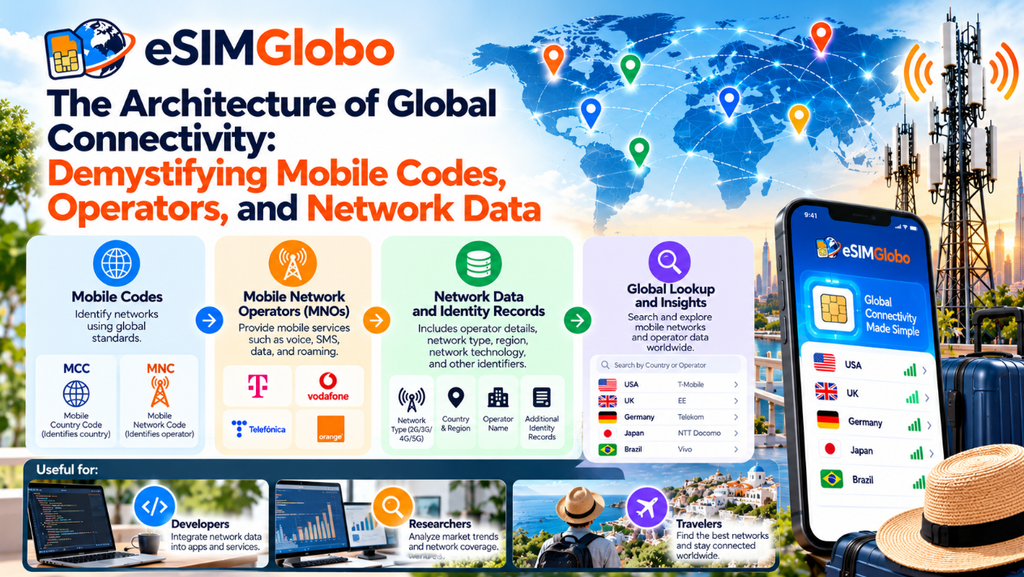
Cellular networks identify themselves using standardized numbering formats defined by the International Telecommunication Union (ITU). The foundational standard for global mobile subscriber identification and network addressing is ITU-T Recommendation E.212. This recommendation specifies the Public Land Mobile Network (PLMN) identity, which consists of two distinct components: the Mobile Country Code (MCC) and the Mobile Network Code (MNC).
+--------------------------------------------------------------------------+
|                  PLMN (Public Land Mobile Network) Identity              |
|                                                                          |
|       MCC (Mobile Country Code)        +      MNC (Mobile Network Code)  |
|            3 Decimal Digits            |          2 or 3 Decimal Digits  |
|      (e.g., 208 for France)            |          (e.g., 01 for Orange)  |
+--------------------------------------------------------------------------+
The Role of the Mobile Country Code (MCC)
The Mobile Country Code consists of three decimal digits. Its primary function is to identify a specific country, a recognized geographic territory, or an international network arrangement. For example, MCC 310, 311, 312, and 313 are assigned to the United States of America, while MCC 234 and 235 belong to the United Kingdom.
It is important to remember that MCCs do not mirror the international calling codes used in telephone numbers (defined under ITU-T E.164). An E.164 country code directs voice calls, whereas an E.212 MCC identifies data and signaling routing paths across radio networks. Furthermore, certain MCC blocks are reserved for global systems, maritime satellite services, or testing environments rather than sovereign nations. Consulting a structured Mobile Country Code List helps researchers identify the exact geographic region or global service band associated with the first three digits of any cellular broadcast.
The Role of the Mobile Network Code (MNC)
The Mobile Network Code follows the MCC and consists of two or three decimal digits. National regulators assign MNCs to specific telecommunications entities operating within their jurisdictions. In some countries, regulators use two-digit MNC formats; in others, such as the United States and Canada, three-digit formats are standard.
Because formatting rules vary by country, handling MNCs requires technical precision. Leading zeros are mathematically meaningful in telecom codes. An MNC formatted as “01” is technically distinct from “001” or “1”. Treating these values as simple integers rather than fixed text strings can break telecom software routing and database queries.
The Combined PLMN Identity
When an MCC and an MNC are joined together, they form a unified PLMN identifier. Performing a PLMN Code Lookup reveals the complete regulatory identity of a mobile network operator. For example, combining the French MCC (208) with the MNC assigned to Orange France (01) yields the PLMN identifier 20801.
This identifier is embedded inside every subscriber identity module (SIM or eSIM) as part of the International Mobile Subscriber Identity (IMSI). When a smartphone searches for coverage, it listens for nearby PLMNs and compares them against the IMSI on the SIM card to decide whether to register directly or initiate an international roaming procedure.
Connecting Numbering Codes to Real Organizations
Finding a raw code on a network log or hardware trace is only the first step. The more practical challenge is identifying the real organization responsible for that code. An assigned identifier does not always point to a well-known retail brand. In many cases, it points to a corporate parent company, a local utility holding a regional radio license, or an infrastructure provider that operates behind the scenes.
A structured Mobile Network Operator Directory bridges the gap between raw signaling codes and verified corporate entities. When researching an assignment, professionals examine several critical data points:
- The Official Assignee: The legal name of the entity that applied to the national telecommunications regulator for the code.
- Regulatory Reference Data: The administrative decree, license number, or official registry filing confirming the assignment.
- Geographic Jurisdiction: The specific country, territory, or regional operating area where the license applies.
- Verification Status: Documentation showing whether the record has been cross-referenced against current official regulator gazettes.
- Historical Changes: A record of corporate mergers, acquisitions, license revocations, or network shutdowns that affect the validity of the code.
+--------------------------------------------------------------------------+
|                       Sample Record Structure                            |
+--------------------------------------------------------------------------+
| Field                  | Example Value                                   |
+------------------------+-------------------------------------------------+
| PLMN Identifier        | 20801                                           |
| Mobile Country Code    | 208 (France)                                    |
| Mobile Network Code    | 01 (Orange)                                     |
| Legal Assignee         | Orange SA                                       |
| Commercial Brand       | Orange                                          |
| Regulatory Authority   | ARCEP (France)                                  |
| Verification Status    | Verified against official regulatory records    |
+------------------------+-------------------------------------------------+
Directory resources such as eSIMGlobo organize these records by cross-referencing national regulatory filings and ITU publications. However, researchers must always keep a critical distinction in mind: the existence of an assigned code does not prove that a mobile network is currently transmitting live radio signals or accepting commercial subscribers. Some codes are assigned for private industrial LTE setups, technical testing, railway communications, or planned deployments that have not yet launched.
Exploring Cellular Assignments Across Borders
Cellular spectrum and numbering resources are managed at both international and domestic levels. The ITU allocates MCC blocks to countries, but individual national telecommunications authorities—such as the FCC in the United States, Ofcom in the United Kingdom, or ARCEP in France—distribute MNCs to licensed operators.
Because national policies differ, the distribution of network codes varies dramatically from one country to another. Some nations have only three or four active mobile network assignments, while others have hundreds of assigned codes reflecting regional operators, emergency service networks, and industrial installations.
| Country / Region | MCC Example | National Regulatory Authority | Common Assignment Structure |
| United States | 310, 311, 312 | Federal Communications Commission (FCC) | 3-digit MNCs; national, regional, and municipal networks |
| United Kingdom | 234, 235 | Office of Communications (Ofcom) | 2-digit and 3-digit MNCs; commercial and private allocations |
| Germany | 262 | Bundesnetzagentur (BNetzA) | 2-digit MNCs; major operators, campus networks, rail |
| Japan | 440, 441 | Ministry of Internal Affairs and Communications (MIC) | 2-digit MNCs; nationwide facilities-based carriers |
Researchers reviewing Mobile Network Codes by Country can study how different regulatory environments handle cellular resources. In open markets with extensive localized licensing, multiple codes may be assigned to municipal utility providers or private campus networks. In other regions, national authorities assign network codes sparingly to preserve available numbering space.
Investigating network records on a country-by-country basis also helps technical teams troubleshoot roaming behavior. For example, when an IoT device travels across an international border, its internal connection manager must cross-reference available local codes against its pre-programmed roaming list. Access to structured geographic references ensures that engineers can anticipate which networks are legally and technically reachable in each destination.
Operators, Brands, and Virtual Networks
A common source of confusion in telecommunications research is the difference between a network infrastructure owner and a retail connectivity brand. Consumers interact with retail storefronts, marketing campaigns, and subscription apps. Telecom protocols, however, only recognize licensed spectrum holders and core network routing identifiers.
+--------------------------------------------------------------------------+
|                      Telecom Ecosystem Architecture                      |
+--------------------------------------------------------------------------+
|                                                                          |
|   [ Mobile Network Operator (MNO) ]                                      |
|   - Owns Radio Spectrum & Antennas (Towers)                              |
|   - Operates Core Network Infrastructure                                 |
|   - Direct Assignee of ITU / Regulator Network Codes                     |
|                                                                          |
|           |                                                              |
|           +--- Wholesale Access Agreement                                |
|           v                                                              |
|                                                                          |
|   [ Mobile Virtual Network Operator (MVNO) ]                             |
|   - Relies on Partner Radio Networks                                     |
|   - May Operate Own Core Network (Full MVNO) or Pure Reseller (Light)   |
|   - Commercial Brand Often Differs from Core PLMN Code                   |
|                                                                          |
+--------------------------------------------------------------------------+
Mobile Network Operators (MNOs)
A Mobile Network Operator owns the physical radio infrastructure—including cellular towers, base stations, and backhaul connections—and holds a direct spectrum license from the government. MNOs are the primary assignees of PLMN codes in national registries. They manage the physical cells that broadcast the MCC and MNC over the air.
Mobile Virtual Network Operators (MVNOs)
A Mobile Virtual Network Operator provides mobile voice and data services to subscribers without owning the underlying radio access network. Instead, an MVNO purchases wholesale network capacity from an established MNO.
MVNO business models differ significantly:
- Full MVNOs: These companies maintain their own core switching systems, home location registers, and billing platforms. Some full MVNOs receive their own independent MNC from national regulators, allowing them to issue their own SIM cards and manage their own international roaming partnerships.
- Light MVNOs and Branded Resellers: These companies handle marketing, billing, and customer care, but rely entirely on the host MNO for core routing and SIM identities. When a customer uses a light MVNO, their phone displays the MVNO’s brand name, but the underlying device registers under the host MNO’s PLMN code.
Because of these diverse arrangements, an MVNO Directory serves a very different analytical purpose than an infrastructure database. An infrastructure directory tracks who owns the radio antennas and assigned spectrum, while a virtual provider directory clarifies the business agreements, wholesale relationships, and service tiers that allow alternative brands to operate.
Maintaining Quality in Telecom Records
Telecommunications data is constantly changing. Operators merge, sell infrastructure assets, rebrand retail operations, surrender obsolete spectrum licenses, and deploy new network generations. Consequently, maintaining an accurate Telecom Operator Database requires continuous verification and structured data hygiene.
High-quality telecom directories rely on several foundational data principles:
+--------------------------------------------------------------------------+
|                        Data Verification Pipeline                        |
+--------------------------------------------------------------------------+
|                                                                          |
|  [Official Source Documents]   -->  ITU Recommendations & Regulators     |
|              |                                                           |
|              v                                                           |
|  [Normalization Engine]        -->  Standardize MCC/MNC Lengths & Names   |
|              |                                                           |
|              v                                                           |
|  [Provenance & History]        -->  Record Modification Dates & Licenses |
|              |                                                           |
|              v                                                           |
|  [Independent Directory]       -->  Public Reference (e.g., eSIMGlobo)   |
|                                                                          |
+--------------------------------------------------------------------------+
- Standardized Formats: Codes must preserve leading zeros and adhere to the strict character definitions set forth in ITU E.212 standards.
- Clear Provenance: Every record should reference an official source document, such as a gazette notification from a national communications ministry or an ITU operational bulletin.
- Audit Trails and Modification Dates: Telecom analysts must know when a record was last confirmed against primary sources. An assignment that was accurate five years ago may have been reassigned following an operator consolidation.
- Handling Ambiguity: When an operator operates multiple non-contiguous networks or shares a code with a regional partner, the database must document these exceptions rather than flattening them into a generic label.
Independent platforms like eSIMGlobo prioritize these verification standards. By presenting documented source histories and verification flags alongside network identifiers, eSIMGlobo helps researchers distinguish confirmed regulatory data from casual, unverified internet summaries.
Researching the Emerging eSIM Marketplace
The rapid adoption of embedded SIM (eSIM) technology has transformed consumer and enterprise connectivity. An eSIM is a programmable chip soldered directly into a smartphone, wearable, or industrial sensor. Instead of inserting a physical plastic card, users download a digital profile over the air through Remote SIM Provisioning protocols defined by the GSMA.
This technological shift has created a vibrant international connectivity market. Travelers and remote workers can purchase temporary international data profiles from specialized online vendors without visiting a local phone store. However, navigating this market introduces new research challenges.
Many digital eSIM storefronts are not mobile network operators. Instead, they operate as digital service brokers, roaming aggregators, or specialized virtual operators. A single commercial eSIM profile may bundle wholesale access to three different local carriers in one destination, while routing traffic through an entirely separate core network in another region.
When evaluating services, researchers look for transparent details regarding:
- Supported Destinations: Clear lists of countries and territories with confirmed local coverage.
- Underlying Network Tiers: Whether the service connects to local 4G, 5G, or low-power IoT networks.
- Traffic Routing and Latency: The physical location of the packet gateway, which directly affects connection speed and latency.
- Regulatory Compliance: Adherence to local telecommunications rules and lawful registration standards.
To help industry researchers and consumers navigate these service tiers, eSIMGlobo plans to introduce a dedicated eSIM Provider Directory as part of its future roadmap. While its current live platform remains focused on core network operators and official code lookup tools, expanding into commercial eSIM provider comparisons represents a natural progression toward broader telecom transparency.
How Developers Work with Telecom Data
For modern software teams, telecommunications identifiers are critical inputs across multiple technical workflows. Automated applications rely on network reference data to optimize performance, prevent fraud, and manage connected devices.
+--------------------------------------------------------------------------+
|                       Common Developer Use Cases                         |
+--------------------------------------------------------------------------+
|                                                                          |
|  [IoT Fleet Management]      -->  Detect roaming status & optimize APN   |
|                                   configurations based on serving PLMN.  |
|                                                                          |
|  [Fraud & Risk Analysis]     -->  Flag unexpected SIM swapping and       |
|                                   unusual international carrier hops.    |
|                                                                          |
|  [Connectivity Routing]      -->  Select the lowest-cost local network   |
|                                   partner for multi-IMSI deployments.    |
|                                                                          |
+--------------------------------------------------------------------------+
1. IoT and Embedded Device Management
Internet of Things devices deployed in logistics, agriculture, or asset tracking often cross international borders. Device firmware can monitor the currently connected network code and compare it against an internal database. If the device connects to an expensive roaming carrier, the software can trigger a search for a more cost-effective local network partner.
2. Fraud Prevention and Identity Verification
Financial technology platforms and security vendors use mobile network information to evaluate transaction risk. When an application verifies a user via SMS two-factor authentication, it may check the user’s mobile carrier. If a user’s phone number suddenly moves from an established national carrier to an unverified private operator code, the system can flag the transaction for potential SIM-swap fraud.
3. Programmatic Data Integration
To support these automated systems, developers frequently require programmatic access to structured telecom tables. While many teams currently rely on periodic database dumps or manual data imports, an MCC MNC Lookup API represents a valuable planned capability for platforms handling telecom intelligence. Programmatic queries could allow software platforms to resolve unknown network codes in real time, validating carrier identities and keeping enterprise systems synchronized with the latest regulatory assignments.
Best Practices for Verifying Telecom Data
Because telecommunications assignments are subject to regulatory updates and commercial reorganizations, technical teams should adopt structured verification practices. Relying on unverified third-party lists can lead to connection failures, inaccurate analytical reports, and costly configuration errors.
+--------------------------------------------------------------------------+
|                     Telecom Data Verification Checklist                  |
+--------------------------------------------------------------------------+
| [ ] 1. Confirm the primary regulatory source (ITU or national authority).|
| [ ] 2. Check the document publication or revision date.                  |
| [ ] 3. Verify exact digit string formatting, preserving leading zeros.   |
| [ ] 4. Distinguish legal assignee identity from consumer retail brands.  |
| [ ] 5. Confirm whether the code is allocated for commercial or private use.|
+--------------------------------------------------------------------------+
When reviewing telecommunications data, consider the following best practices:
- Trace Data Back to Primary Regulators: Whenever possible, verify an assignment against reports published by national telecom ministries or the ITU’s regular operational bulletins.
- Check the Record Date: Always verify when a record was last updated. Mergers and spectrum re-allocations can make records obsolete within a few years.
- Treat Identifiers as Text Strings: Always store and process MCC and MNC entries as text strings rather than numeric integers to prevent the accidental loss of leading zeros (e.g., preserving
01instead of converting it to1). - Distinguish Code Ownership from Network Availability: Remember that possessing a licensed code does not necessarily mean an operator has active radio transmissions covering an entire country. Always confirm physical coverage through independent technical validation.
Using eSIMGlobo for Network Discovery
Navigating global telecommunications information can be challenging when records are scattered across dozens of languages, government websites, and technical repositories. eSIMGlobo addresses this challenge by functioning as an independent Global Telecom Provider Directory.
The platform is designed to make telecom research straightforward and accessible. Whether you are an engineer investigating an unfamiliar network identifier, a student learning the fundamentals of cellular communications, or an analyst researching global connectivity providers, eSIMGlobo provides clean, organized records.
Users can quickly perform an MCC MNC Lookup to find the legal assignee behind an unknown code or explore regional assignments across various territories. By organizing data with transparent source references and documented verification histories, eSIMGlobo provides a dependable starting point for technical investigation.
As the platform continues to develop, its upcoming initiatives—including expanded directory listings for virtual operators, structured references for the commercial eSIM sector, and planned API access for developers—aim to bring greater clarity and transparency to the global telecommunications ecosystem.
Frequently Asked Questions
What is the difference between an MCC and an MNC?
A Mobile Country Code (MCC) is a three-digit number that identifies a specific country or global geographic area. A Mobile Network Code (MNC) is a two- or three-digit number that identifies a specific network operator within that country. Together, they form a unique PLMN code.
Where does a phone find the network’s PLMN code?
Mobile phones detect PLMN codes directly from cellular base stations. Cellular towers continuously broadcast their assigned MCC and MNC over the air on administrative signaling channels, allowing nearby phones to read the code and identify the carrier.
Does a network code assignment mean an operator has live cellular coverage?
No. An assignment simply indicates that a national telecommunications regulator has allocated the code to an organization. The operator might be in the planning stages of a network buildout, running private laboratory tests, or holding an inactive license.
Can two different mobile network operators share the same MNC?
No two operators within the same country can share the exact same MNC. However, two operators in entirely different countries can have identical MNC values because their three-digit Mobile Country Codes will be different.
How does an MVNO differ from a traditional mobile network operator?
A traditional Mobile Network Operator (MNO) owns physical cellular towers, base stations, and licensed radio spectrum. A Mobile Virtual Network Operator (MVNO) buys network access in bulk from an established MNO and resells connectivity directly to consumers under its own brand.
Why are leading zeros important in mobile network codes?
In telecommunications numbering systems, leading zeros are structurally significant. An MNC formatted as “02” is completely different from an MNC formatted as “20” or “2”. Treating these codes as text strings ensures that critical leading zeros are never erased.
Does an eSIM profile change a device’s hardware identity?
No. An eSIM profile provides a digital subscriber identity (including an IMSI and authentication keys) that securely downloads to an embedded chip inside the phone. It changes which network provider the device registers with, but it does not alter the physical hardware identity of the phone.
What should developers look for when selecting telecom reference data?
Developers should look for directories that provide consistent formatting, clear source references from official regulatory agencies, transparent verification dates, and historical records tracking corporate changes.
Conclusion
The modern global telecommunications framework relies on a structured, mathematically rigorous addressing system. Mobile Country Codes, Mobile Network Codes, and Public Land Mobile Network identifiers work together behind the scenes to route billions of calls, messages, and internet packets across international boundaries every day.
Understanding these identifiers allows telecom professionals, engineers, and digital businesses to look past commercial brand marketing and examine the true infrastructure and regulatory agreements that power international connectivity. As the mobile ecosystem expands to accommodate new technologies such as 5G, massive IoT deployments, and digital eSIM provisioning, reliable reference directories become increasingly vital.
By delivering verified network code lookups, structured operator profiles, and transparent source histories, independent resources like eSIMGlobo help make complex telecom data organized, searchable, and accessible to everyone.