
Introduction
Navigating the modern software engineering landscape often feels like standing in front of an endless wall of technologies. Beginners and experienced engineers alike frequently find themselves overwhelmed by the sheer volume of tools, platforms, and methodologies required to master automated software delivery. Trying to learn every tool at once leads to burnout, confusion, and fragmented knowledge.
The secret to establishing a sustainable career in this field lies in following a structured sequence. Rather than attempting to memorize every technology in existence, building a step-by-step DevOps roadmap allows you to master foundational concepts before adopting advanced tooling. Whether you are transitioning from system administration, moving out of traditional software development, or starting fresh, a well-defined DevOps learning path turns a chaotic ecosystem into a clear, manageable progression.
Start With Engineering Fundamentals
Before touching complex orchestrators or deployment pipelines, you must build a resilient foundation in core computing principles. Advanced automation tools merely abstract lower-level mechanics; without a solid understanding of those mechanics, diagnosing failures becomes nearly impossible.
A comprehensive DevOps engineer roadmap always begins with Linux administration and command-line fluency. Because the vast majority of cloud workloads and container environments run on Linux, understanding file systems, process management, permissions, and bash scripting is non-negotiable. Alongside operating system fundamentals, you must develop a working grasp of networking basics, including TCP/IP, DNS, HTTP/HTTPS protocols, firewalls, and subnetting.
Equally critical at this foundational stage is source control. Git is the single source of truth in modern engineering workflows, making repository management, branching strategies, and merge conflict resolution essential daily skills. Finally, gaining basic programming experience—whether in Python, Go, or Shell scripting—enables you to interact with APIs, process data formats like JSON and YAML, and automate routine operational tasks.
Build the Core DevOps Skill Set
Once you are comfortable with system administration, networking, and version control, you can begin assembling the core capabilities required to build, test, and release software reliably.
At this phase, your focus shifts toward continuous integration and continuous delivery (CI/CD). CI/CD represents the operational engine of modern delivery, automating the journey code takes from a developer’s local machine to production. You will learn how build pipelines run tests, compile binaries, analyze code quality, and package artifacts.
Simultaneously, you must introduce infrastructure management into your skill set. Instead of manually configuring servers and network settings, modern environments rely on automated provisioners and configuration management. Learning how to declare infrastructure via code and automate system states ensures that environments remain consistent, reproducible, and easily auditable across development, staging, and production tiers.
Learn Tools Through Practical Problems
A common trap for aspiring engineers is attempting to learn software tools in isolation without understanding the specific operational challenges they solve. Modern software delivery relies on a diverse ecosystem of specialized DevOps tools, but these technologies are only valuable when applied to real engineering problems.
To build a meaningful capability set, categorize tools by the engineering problem they address:
- Version Control & Collaboration: Git platforms (GitHub, GitLab) manage code history and collaborative workflows.
- Continuous Integration & Delivery: Pipelines (Jenkins, GitHub Actions, GitLab CI, ArgoCD) automate building, testing, and deployment processes.
- Containerization & Orchestration: Runtime engines (Docker) package applications with their dependencies, while orchestrators (Kubernetes) manage container scheduling, scaling, and networking at scale.
- Infrastructure as Code (IaC): Declarative tools (Terraform, OpenTofu, CloudFormation) provision and manage cloud resources programmatically.
- Configuration Management: Automation engines (Ansible, Puppet) maintain desired system states and configurations across fleets of servers.
- Observability & Monitoring: Platforms (Prometheus, Grafana, ELK Stack, Datadog) collect metrics, logs, and traces to monitor application health and performance.
Understanding how these categories fit together allows you to select the right tool for a specific operational challenge rather than collecting software titles for your resume.
How to Compare DevOps Tools
When designing an operational stack or choosing what to study next, conducting a objective DevOps tools comparison helps you select technologies based on project requirements rather than industry hype.
When evaluating competing technologies, consider the following structural factors:
| Evaluation Factor | Engineering Considerations |
| Primary Purpose & Scope | Does the tool solve a broad orchestration problem or a narrow configuration task? |
| Deployment & Hosting Model | Is it a self-hosted open-source application or a fully managed cloud service? |
| Ecosystem & Integrations | How easily does it connect with your existing version control, cloud providers, and security platforms? |
| Learning Curve & Complexity | What is the operational overhead required to deploy, upgrade, and maintain the tool in production? |
| Automation Capabilities | Does it offer robust APIs, CLI tools, and declarative configuration options? |
| Community & Documentation | Is there an active community, extensive vendor support, and reliable troubleshooting documentation? |
No single tool wins in every category. The best choice always depends on an organization’s existing architecture, technical maturity, security compliance requirements, and team capabilities.
Move Toward Reliability and Operations
As your understanding of automation and cloud infrastructure matures, your focus must expand to include system availability, resilience, and operational health. This is where Site Reliability Engineering (SRE) principles intersect with traditional delivery pipelines.
An effective SRE roadmap emphasizes maintaining system stability while preserving engineering velocity. SRE applies software engineering disciplines to operational problems. Key focus areas include defining Service Level Indicators (SLIs) and Service Level Objectives (SLOs), establishing error budgets to balance risk against innovation, and building automated incident response workflows.
While standard delivery practices concentrate on moving code efficiently from repository to deployment, reliability engineering ensures those applications remain healthy under heavy traffic, network partitioning, and hardware failures. Mastering metrics collection, distributed tracing, centralized logging, capacity planning, and automated blameless post-mortems prepares you to manage large-scale distributed systems.
Explore Platform Engineering
In recent years, the engineering discipline has evolved to address developer friction and operational cognitive overload. Rather than requiring every developer to become an expert in cloud infrastructure, networking, and deployment pipelines, organizations are increasingly establishing dedicated platform teams.
A modern Platform Engineering roadmap builds upon core infrastructure knowledge to focus on creating Internal Developer Platforms (IDPs). Platform engineers design self-service portals, standardized application templates, and automated workflows that allow developers to deploy and manage their own workloads securely without needing deep expertise in lower-level infrastructure.
Platform engineering represents a natural career progression for experienced infrastructure engineers. By abstracting complex cloud and orchestration mechanics behind golden paths and automated self-service interfaces, platform teams reduce developer cognitive load while enforcing organization-wide security, compliance, and cost-control standards.
Understand Certifications Strategically
Industry credentials play a distinct role in modern technical careers, but they must be approached with realistic expectations. Pursuing targeted DevOps certifications can provide structured study pathways and validate your theoretical knowledge to potential employers.
When evaluating certifications, follow a clear DevOps certification roadmap aligned with your career experience level:
- Foundational Cloud Credentials: Entry-level certifications (e.g., AWS Certified Cloud Practitioner, Microsoft Certified: Azure Fundamentals) validate basic cloud concepts and terminology.
- Associate & Administrator Level: Practical credentials (e.g., AWS Certified Solutions Architect – Associate, Certified Kubernetes Administrator – CKA) test hands-on command-line skills, architecture design, and real-time troubleshooting.
- Advanced & Professional Level: Specialized credentials (e.g., AWS Certified DevOps Engineer – Professional, Certified Kubernetes Security Specialist – CKS) demonstrate advanced system architecture, security hardening, and complex multi-region delivery design.
Certifications demonstrate dedication and foundational understanding, but they are not a substitute for hands-on engineering capabilities. Employers view credentials most favorably when backed by practical repositories, technical documentation, and real-world troubleshooting skills.
Build Projects Before Chasing Every Tool
The most effective way to consolidate theoretical knowledge into actual engineering capability is by building end-to-end practical projects. Rather than running isolated commands from a tutorial, design projects that mirror production environments and real operational challenges.
Consider building projects around these common real-world scenarios:
- Automated Web Application Delivery: Create a sample web application, store its source code in Git, and build a CI/CD pipeline that automatically runs unit tests, builds a container image, and publishes it to a registry.
- Containerized Infrastructure Provisioning: Write declarative Infrastructure as Code scripts to provision a cloud virtual network, security groups, and an orchestrator cluster automatically.
- Observability Stack Implementation: Deploy an application alongside Prometheus and Grafana, configure custom application metrics, set up log aggregation, and build active alerts triggered by simulated service failures.
- GitOps & Continuous Deployment: Configure automated cluster synchronization using GitOps controllers so that updates to a configuration repository automatically roll out to your Kubernetes cluster.
Always document your project architecture, design choices, trade-offs, and troubleshooting steps in your public code repositories. Clear documentation demonstrates software engineering maturity far better than a simple code upload.
Connect Learning With Career Preparation
Navigating the job market successfully requires translating technical exercises into evidence of practical problem-solving capabilities. When applying for DevOps jobs, candidates who can articulate why they chose a specific technology or how they diagnosed a complex infrastructure failure stand out immediately.
Focus your career preparation on building a public repository portfolio containing clear, well-documented architecture diagrams, infrastructure scripts, and pipeline definitions. Practice explaining core system design principles, such as load balancing, state management, disaster recovery, and security perimeter defense.
Additionally, dedicate time to developing troubleshooting instincts. Employers regularly ask technical candidates to walk through simulated outage scenarios during interviews. Demonstrating a methodical, calm approach to isolating root causes—checking network connectivity, parsing log files, inspecting container resource limits, and evaluating recent system changes—is often the decisive factor in technical hiring decisions.
How DevOpsSchool.org Can Support the Learning Journey
Finding structured, high-quality technical guidance can significantly accelerate your learning path. Platforms like DevOpsSchool.org provide open, community-oriented educational resources designed specifically to support modern software engineering careers.
Engineers at any stage of their career can leverage DevOpsSchool.org to access:
- Structured Learning Pathways: Guided 90-day learning schedules covering core DevOps, SRE, Platform Engineering, DevSecOps, and MLOps principles.
- Technology Directories: Curated reference indexes breaking down tooling categories across CI/CD, containerization, Infrastructure as Code, and observability.
- Certification Research Resources: In-depth breakdowns of certification formats, syllabus requirements, preparation guides, and practical exam advice.
- Practical Tutorials & Exercises: Hands-on labs, real-world deployment scenarios, and interview preparation content tailored for technical evaluations.
By combining structured learning frameworks with natural problem-solving practices, educational platforms help bridge the gap between initial technical curiosity and professional engineering capability.
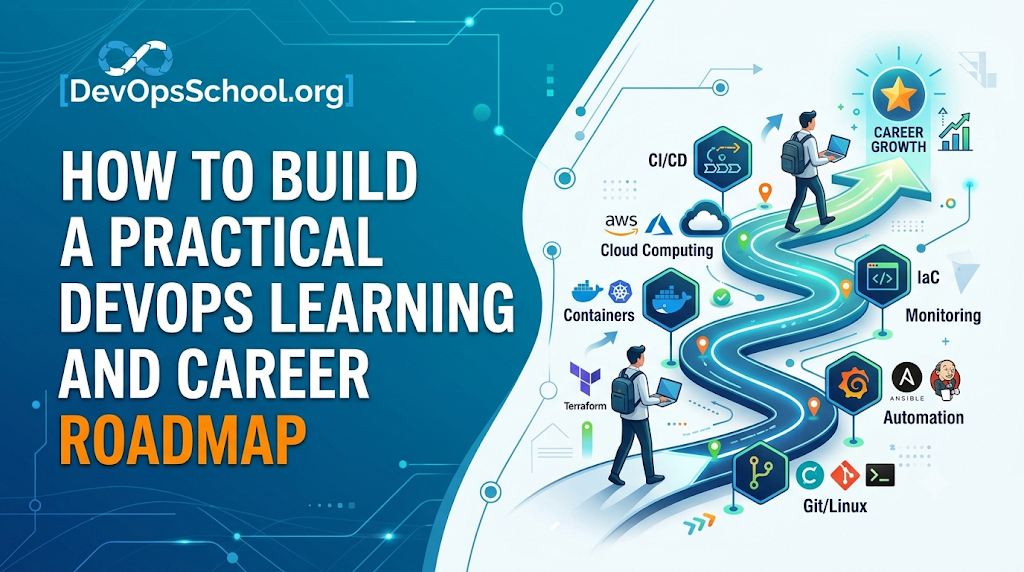
Practical DevOps Learning Framework
To avoid feeling overwhelmed, approach your career progression using this logical, sequential framework:
- Fundamentals: Master Linux system administration, bash terminal commands, networking fundamentals, and Git repository management.
- Automation & Scripting: Learn basic programming (Python or Go) to interact with REST APIs, parse operational data, and write automated scripts.
- CI/CD Pipelines: Build continuous integration workflows that automate code testing, artifact building, and security scanning.
- Containerization: Package applications into Docker containers, managing multi-container local environments with container orchestration tools.
- Cloud Infrastructure: Understand core cloud services including virtual compute, object storage, virtual private clouds, and Identity and Access Management (IAM).
- Kubernetes & Orchestration: Deploy, scale, and manage containerized workloads in production-grade Kubernetes environments.
- Infrastructure as Code: Automate cloud provisioning using declarative IaC tools like Terraform or OpenTofu.
- Observability & Monitoring: Implement centralized logging, metrics collection, distributed tracing, and real-time operational alerting.
- Security Integration: Incorporate automated static code analysis, vulnerability scanning, and secrets management directly into delivery pipelines.
- Reliability & Specialization: Adopt SRE practices, explore platform engineering principles, or pursue advanced certifications aligned with your target career track.
- Career Preparation: Build documented project portfolios, refine system design principles, and practice methodical troubleshooting techniques.
Common Mistakes to Avoid
- Learning Too Many Tools Simultaneously: Focus on understanding underlying engineering concepts rather than attempting to learn every trendy tool on the market.
- Skipping Linux and Networking Basics: Attempting to manage cloud orchestrators without command-line and networking fluency leads to extreme frustration during troubleshooting.
- Collecting Certifications Without Hands-on Practice: Pursuing credentials without supporting code repositories or practical project experience creates a false sense of readiness.
- Copying Tutorials Without Understanding: Blindly executing code snippets without analyzing how components interact prevents the development of actual engineering judgment.
- Ignoring Troubleshooting & Observability: Spending all your time on deployment setups while neglecting log analysis, metrics, and debugging techniques leaves you unprepared for real-world outages.
- Treating DevOps as a Toolset Rather Than a Discipline: Focusing exclusively on operational tools while ignoring collaboration, communication, and process improvement misses the fundamental purpose of modern engineering culture.
FAQs
How long does it take to learn DevOps?
Building a functional entry-level capability set typically takes six to nine months of consistent, structured study. Transitioning effectively depends heavily on your prior background in system administration or software development.
Should beginners learn cloud before Kubernetes?
Yes. Understanding core cloud concepts—such as virtual networks, compute instances, storage volumes, and IAM roles—is essential before managing complex container orchestrators like Kubernetes.
Are DevOps certifications necessary for a DevOps career?
Certifications are not strictly mandatory, but they provide clear study structure and help validate your theoretical understanding to recruiters. Practical project repositories and troubleshooting capabilities remain the primary factors in hiring decisions.
What should a beginner include in a DevOps project portfolio?
A well-rounded portfolio should include a public repository containing automated CI/CD pipelines, containerized application setups, declarative Infrastructure as Code templates, and an operational observability configuration complete with clear documentation.
How should someone choose between DevOps, SRE, and Platform Engineering?
Focus on core infrastructure and delivery fundamentals first. As your skills mature, choose traditional delivery engineering if you enjoy continuous integration workflows, SRE if you prefer system reliability and operational performance, or Platform Engineering if you enjoy building self-service tools for developer teams.
Conclusion
Building a successful career in modern software engineering does not require mastering every tool available overnight. By following a structured sequence—starting with core system fundamentals, progressing through automated delivery pipelines, and expanding into cloud infrastructure and observability—you can build sustainable engineering expertise without becoming overwhelmed.
Focus on understanding the engineering challenges behind technologies, building practical project portfolios, and refining your real-world troubleshooting capabilities. As you navigate your learning journey, open platforms like DevOpsSchool.org serve as valuable resources, offering structured learning paths, technology guides, certification research, and career navigation materials to support your technical growth every step of the way.

