
Introduction
The landscape of modern reproductive medicine has expanded rapidly, giving individuals and couples access to an unprecedented amount of clinical data, educational resources, and provider directories. However, navigating this wealth of material can quickly become overwhelming. Anyone beginning this journey encounters an intricate web of clinical terminology, wide variations in advertised pricing, complex outcome statistics, and distinct differences between domestic and cross-border options.
Because medical marketing often blurs the line between genuine clinical education and commercial promotion, establishing an objective, step-by-step research strategy is essential. A structured approach allows prospective patients to cut through digital noise, understand diagnostic and therapeutic pathways, and prepare meaningful questions for clinical consultations.
The Spectrum of Modern Reproductive Care
Fertility medicine is not a one-size-fits-all discipline. The clinical path recommended by a reproductive endocrinologist depends on an array of diagnostic markers, including hormonal profiles, ovulatory function, tubal patency, semen parameters, genetic screening, and underlying conditions such as polycystic ovary syndrome (PCOS) or endometriosis.
When exploring fertility treatment options, patients typically encounter a spectrum ranging from conservative interventions to advanced laboratory procedures:
- Ovulation Induction: Medication protocols designed to stimulate the development and release of mature eggs in individuals with irregular ovulatory cycles.
- Intrauterine Insemination (IUI): A procedure where prepared sperm is placed directly into the uterus around the time of ovulation, often used for mild male-factor challenges or unexplained subfertility.
- Assisted Reproductive Technology (ART): Advanced laboratory techniques, including in vitro fertilization, donor-assisted reproduction, and gestational carrier arrangements.
- Fertility Preservation: Elective or medically indicated cryopreservation of oocytes, sperm, or ovarian tissue for future reproductive use.
Understanding these categories conceptually helps individuals discern which topics apply to their stage of investigation without mistaking general overviews for personalized clinical advice.
Understanding Laboratory Fertilization Techniques
Within assisted reproduction, laboratory techniques vary based on diagnostic indications. The discussion surrounding ICSI vs IVF often centers on how fertilization occurs once mature oocytes are retrieved.
In standard in vitro fertilization (IVF), retrieved eggs and a concentrated sample of motile sperm are placed together in a specialized culture dish, allowing fertilization to occur organically in an incubator. This protocol is commonly used when semen parameters are within expected clinical ranges or when tubal factors are the primary indication.
Intracytoplasmic sperm injection (ICSI), by contrast, is a micromanipulation procedure where a single, structurally normal sperm is selected and injected directly into the cytoplasm of a mature egg. Clinicians frequently discuss ICSI in cases involving low sperm count, reduced motility, atypical morphology, prior fertilization failure, or when utilizing surgically retrieved sperm.
Grasping these distinct technical definitions enables patients to understand treatment proposals and evaluate laboratory capabilities without feeling intimidated by clinical shorthand.
Evaluating Clinical Standards and Facilities
Selecting a healthcare facility involves much more than reviewing aesthetic websites or reading promotional brochures. When prospective patients begin to evaluate and compare IVF clinics, they should look closely at operational infrastructure, clinical transparency, and patient care systems.
Key operational areas to investigate include:
- Clinical Experience and Qualifications: The training, board certifications, and subspecialties of the reproductive endocrinologists, embryologists, and nursing teams.
- Laboratory Accreditation: The presence of rigorous regulatory oversight and certifications from recognized bodies, as laboratory air quality, incubation technology, and quality-control protocols directly influence culture conditions.
- Range of Diagnostic and Treatment Services: Whether the facility offers comprehensive in-house diagnostics, genetic testing interfaces, and specialized cryopreservation facilities, or relies heavily on external contractors.
- Care Continuity and Monitoring: How patient communication is managed, whether an assigned clinical team handles monitoring, and what emergency protocols exist outside standard business hours.
- Transparent Billing and Inclusions: Clear disclosure of baseline fees versus optional add-on procedures such as extended embryo culture, specialized micromanipulation, or cryostorage.
Independent educational platforms such as IVFHospitalsNow.com serve as helpful starting points during this phase, offering non-commercial directories and educational overviews that help patients organize their questions before speaking directly with licensed medical directors.
Assessing Geographic Proximity and Daily Logistics
Geographic convenience is a major practical factor in reproductive medicine. An assisted reproductive cycle is logistically demanding, often requiring frequent clinic visits over a two- to three-week window for transvaginal ultrasounds and serum hormone monitoring.
Consequently, searches for IVF clinics near me are common among those balancing full-time employment, family commitments, and intensive treatment protocols. Proximity reduces commuting stress and facilitates early-morning appointments.
However, convenient location should never replace rigorous evaluation of clinical standards. While a nearby center minimizes logistical hurdles, patients must balance transit time against laboratory quality, physician expertise, and overall institutional transparency. Proximity makes active monitoring manageable, but clinical suitability remains paramount.
Deconstructing Financial Components
Navigating reproductive care costs requires a detailed look beneath summary package quotes. The overall IVF treatment cost can vary significantly because a complete cycle comprises several distinct phases, each carrying independent expenses.
A standard cycle commonly includes the following cost categories:
- Preliminary Diagnostics: Baseline blood panels, infectious disease screenings, semen analyses, and uterine cavity evaluations.
- Ovarian Stimulation Medications: Injectable gonadotropins and cycle-suppression drugs, which are prescribed individually and frequently billed directly by specialty pharmacies rather than the clinic.
- Cycle Monitoring: Serial pelvic ultrasounds and blood tests performed over several days to assess follicular growth and adjust medication dosing.
- Surgical and Anesthetic Procedures: Oocyte aspiration fees, facility use charges, and anesthesia administration.
- Embryology Services: Insemination, standard culture, micromanipulation (if indicated), and embryo cryopreservation.
- Ancillary and Ongoing Fees: Pre-implantation genetic testing biopsies, administrative coordination fees, and ongoing maintenance charges for frozen gametes or embryos.
Prospective patients should always request an itemized financial disclosure sheet to determine exactly which clinical services are bundled into a quoted baseline fee and which items will generate separate out-of-pocket bills. Resources like IVFHospitalsNow.com frequently detail these common financial breakdowns to assist readers in building realistic comparative budgets.
Investigating Cross-Border Medical Options
For reasons involving cost management, donor availability, legal frameworks, or specialized laboratory access, some patients explore IVF treatment abroad. Traveling internationally for medical procedures—often termed cross-border reproductive care—requires thorough due diligence beyond standard domestic research.
Critical factors to verify before pursuing treatment in another country include:
- Legal and Regulatory Standards: National laws governing assisted reproduction vary considerably. Rules regarding donor anonymity, embryo storage limits, access criteria, and genetic screening differ widely across jurisdictions.
- Transfer of Medical Records: Ensuring that local physicians and international facilities can seamlessly share diagnostic test results, ultrasound imaging, and treatment summaries.
- Language and Communication: Confirming that the clinical staff provides clear, documented communication in the patient’s primary language, particularly regarding medication administration schedules and urgent concerns.
- Travel and Logistical Continuity: Managing long-distance travel while undergoing ovarian stimulation, navigating potential flight delays, and securing appropriate travel insurance that accounts for outpatient medical procedures.
- Post-Procedure Care: Establishing a plan with a local primary care physician or gynecologist for early pregnancy monitoring or the management of rare complications after returning home.
Cross-border options can offer viable pathways, but patient safety relies on verifiable regulatory compliance and seamless continuity of care.
Analyzing Global Cost Variations
When evaluating international pricing structures, assessing the IVF cost by country demands a comprehensive accounting mindset. Advertised international packages may appear substantially lower than domestic averages, but headline figures rarely represent the total financial outlay.
A thorough cross-border financial comparison should evaluate:
- Package Inclusions and Exclusions: Determining whether an advertised fee covers stimulation medications, ICSI, blastocyst culture, embryo freezing, and initial storage, or only basic clinical procedures.
- Travel and Extended Lodging: Factoring in multiple weeks of accommodation, daily living expenses, and international flights for one or both partners.
- Currency Fluctuation: Accounting for exchange-rate movements and foreign transaction charges that may alter total expenditure between initial planning and final payment.
- Redundant Diagnostics: Potential costs associated with repeating baseline screenings if an overseas facility requires testing performed in its proprietary laboratories.
- Contingency Costs: Budgeting for unexpected cycle cancellations, extended stays due to delayed ovarian response, or additional frozen embryo transfers.
Rigorous comparison ensures that decisions are guided by total real-world expenditures and clinical standards rather than incomplete promotional price points.
Interpreting Clinical Outcome Data
Outcome figures are among the most frequently cited—and frequently misunderstood—metrics in reproductive healthcare. While reviewing IVF success rates is a standard step in evaluating prospective clinics, these percentages must be read with clinical nuance.
The Centers for Disease Control and Prevention (CDC) notes that clinic-specific outcome data must be interpreted carefully, as patient populations and clinical admission criteria differ widely between practices. A clinic that accepts challenging clinical cases or older patients may report lower overall statistical percentages than a clinic that implements strict patient selection thresholds.
When reviewing published data, consumers should examine the methodology behind the metrics:
- Denominator Definition: Determine whether the percentage reflects live births per initiated cycle, per egg retrieval, or per embryo transfer. A rate calculated per embryo transfer appears higher because it excludes cycles canceled prior to retrieval or transfer.
- Age Stratification: Evaluate outcomes categorized within specific age brackets rather than broad clinic-wide averages.
- Transfer Modality: Check whether figures represent fresh embryo transfers, frozen embryo transfers, or cumulative outcomes across multiple attempts.
- Reporting Verification: Verify whether the data is officially audited by national registries (such as the CDC or SART in the United States, or the HFEA in the United Kingdom) rather than self-reported on marketing materials.
Clear data comprehension prevents misleading comparisons and helps set evidence-based expectations.
Assessing Cryopreservation Expenses
Oocyte cryopreservation has become an increasingly utilized pathway for individuals seeking to preserve biological options for medical or personal reasons. Investigating the overall egg freezing cost requires looking past the initial retrieval phase to calculate the cumulative lifetime investment.
A complete financial assessment includes several components:
- Initial Diagnostic Testing: Anti-Müllerian Hormone (AMH) tests, baseline antral follicle counts, and infectious disease screenings.
- Ovarian Stimulation and Monitoring: Prescription hormonal medications and multiple clinical ultrasound and blood monitoring visits.
- Retrieval and Vitrification: The surgical aspiration procedure, anesthesia administration, and laboratory cryopreservation protocols.
- Long-Term Cryostorage: Annual maintenance fees for maintaining frozen oocytes in liquid nitrogen storage dewars, which accrue year after year.
- Future Thawing and Insemination: Eventual costs associated with thawing, laboratory fertilization via ICSI, embryo culture, and uterine transfer procedures years down the road.
Understanding the cumulative expense ensures prospective patients budget accurately for both the immediate preservation cycle and future utilization.
Critically Appraising Online Health Information
Digital health literacy is an essential skill when researching specialized medical topics. Search engine algorithms and social channels often highlight engaging anecdotes, sponsored advertisements, and promotional claims above validated scientific literature.
To verify the credibility of digital medical information, readers should evaluate several core indicators:
- Authorship and Clinical Review: Check whether articles are written or formally reviewed by credentialed medical professionals, such as board-certified reproductive endocrinologists or embryologists.
- Citations and Evidence: Reliable educational material clearly references peer-reviewed scientific journals, guidelines from professional societies (like ASRM or ESHRE), or institutional health data.
- Publication and Revision Dates: Reproductive medicine evolves continually. Ensure that protocols, statistics, and technological descriptions reflect current clinical standards.
- Commercial Transparency: Differentiate between neutral educational materials and content sponsored by specific commercial vendors, private-equity networks, or pharmaceutical brands.
Maintaining a healthy skepticism toward personal testimonials, social media trends, and promotional promises protects patients from misinformation and commercial bias.
A Systematic Framework for Patient Research
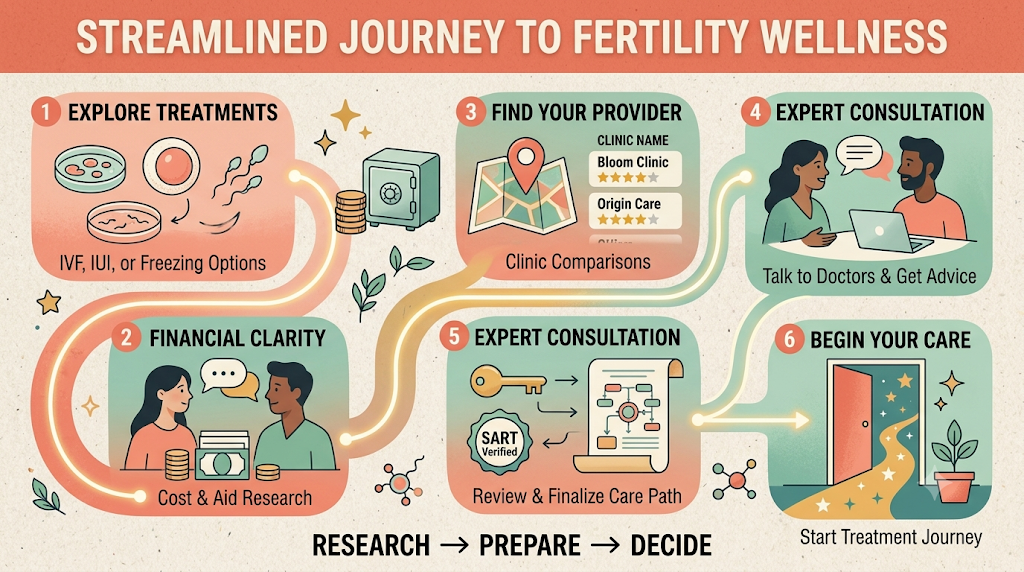
Approaching reproductive research systematically prevents decision fatigue and fosters productive clinical consultations. Patients can navigate their investigations using a six-stage framework:
- Research: Gather foundational knowledge regarding human reproduction, common diagnostic pathways, and clinical procedures from accredited medical sources and independent educational portals.
- Understand: Master baseline terminology—such as the difference between standard culture and micromanipulation, or the components of a medication protocol—to decode clinical descriptions.
- Compare: Evaluate multiple facilities across standardized benchmarks, including laboratory credentials, physician backgrounds, diagnostic capabilities, and transparent pricing structures.
- Verify: Validate clinical outcome figures against official regulatory registries, confirm physician licensure, and check laboratory accreditations.
- Ask: Prepare an organized list of questions regarding protocol choices, cycle inclusions, out-of-pocket expenses, and monitoring arrangements for your initial consultation.
- Decide: Work in direct partnership with a licensed medical professional to make informed personal choices based on validated diagnostics and professional medical guidance.
Essential Questions for Clinical Inquiries
Before committing to a specific medical facility, patients can utilize the following checklist to guide their direct conversations with clinical and administrative staff:
- Which specific diagnostic evaluations are required prior to initiating a treatment cycle, and can recent external test results be utilized?
- What is the specific background and board certification of the reproductive endocrinologists and laboratory director?
- Are monitoring appointments handled by physicians, specialized clinical nurse practitioners, or sonographers?
- What embryology technologies are utilized in the laboratory, and how are quality assurance and environmental controls audited?
- Can the clinic provide an itemized financial quote outlining standard procedure fees, medication estimates, anesthesia charges, and annual cryostorage rates?
- What contingency plans and financial policies apply if a cycle must be converted or canceled prior to retrieval?
- How are emergency calls, after-hours medical concerns, and weekend monitoring handled?
Independent Educational Portals
Navigating the reproductive medicine landscape is significantly simpler when leveraging independent, non-commercial educational tools. Independent platforms like IVFHospitalsNow.com provide centralized directories, educational articles, and structural comparisons that help prospective patients familiarize themselves with treatments, diagnostic requirements, and financial benchmarks.
By operating as an educational resource rather than a medical provider, such platforms support patients during the initial information-gathering phase, helping them build the literacy needed to communicate effectively with licensed healthcare providers.
Clarifying Common Inquiries
How should prospective patients evaluate and compare IVF clinics?
Evaluating clinics requires reviewing laboratory accreditations, physician credentials, and the breadth of in-house diagnostic services. Patients should look past marketing claims and assess institutional transparency, clarity regarding itemized billing, and verifiable outcome reporting through official regulatory registries.
What primary factors influence overall IVF treatment cost?
Overall expenses depend on the specific diagnostic tests required, the customized dosage of ovarian stimulation medications, laboratory micromanipulation services, anesthesia fees, and ancillary options such as genetic testing or long-term embryo cryostorage. Package inclusions must be reviewed carefully to identify potential separate charges.
How should published IVF success rates be interpreted?
Outcome statistics should be examined by specific age category and calculated per initiated cycle rather than exclusively per embryo transfer. It is critical to confirm whether figures are audited by official national databases and to recognize that patient intake criteria can substantially affect a clinic’s raw percentages.
What should individuals consider before pursuing fertility care overseas?
Key considerations include national regulatory laws governing assisted reproduction, the transferability of medical documentation, travel logistics during ovarian stimulation, language accessibility, and established follow-up care with a local physician upon returning home.
What ongoing expenses contribute to the total egg freezing cost?
Beyond initial consultation fees, stimulation medications, surgical retrieval, and laboratory vitrification, individuals must budget for annual liquid nitrogen cryostorage fees, as well as the eventual costs of thawing, fertilization, and embryo transfer in future years.
Conclusion
A methodical, well-informed research process transforms an otherwise daunting medical journey into an empowering healthcare exploration. By understanding treatment definitions, demanding financial transparency, critically reviewing clinical data, and relying on reputable educational resources, individuals can make informed, confident decisions alongside qualified medical specialists.

