
Introduction
Every academic year brings the same pressure for Indian families. A student struggles with high school physics, or a parent searches for structured support before board exams. Later, the challenge shifts toward entrance tests, entrance rankings, and college applications.
Good choices save time, reduce stress, and protect family finances. Poor choices lead to burnout, wasted academic terms, and frustration.
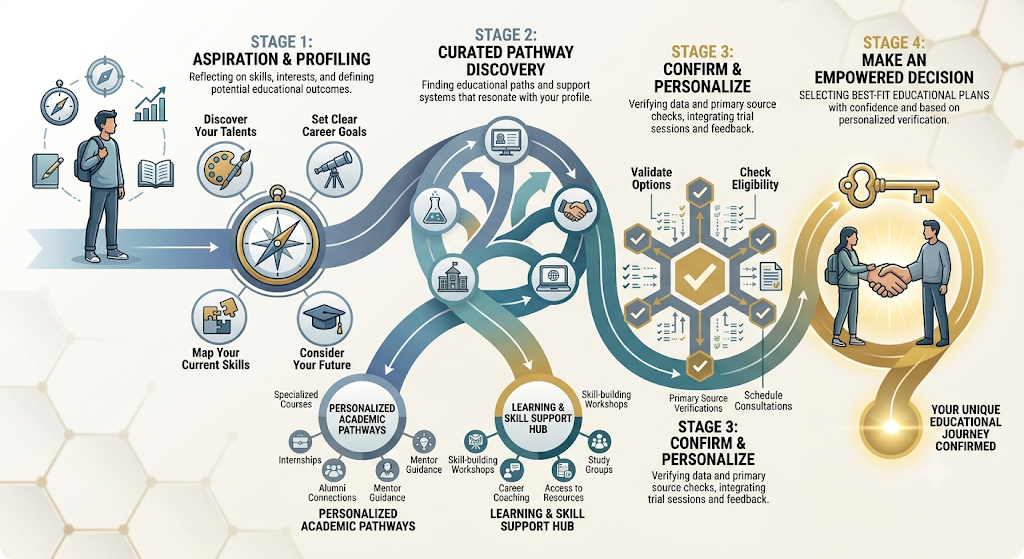
Making smart educational decisions does not require guesswork. You do not need to rely on billboard claims or word-of-mouth rumours. Instead, you need a clear, objective system to compare options. Whether you need to find tutors online, choose between coaching batches, or shortlist colleges, following a structured process helps you make decisions with confidence.
Step 1: Diagnose the Exact Learning Need
Before you search for classes or private teachers, identify the specific academic problem you want to solve. Many parents hire tutors immediately when marks drop, assuming more study hours will fix the issue. Often, the root cause is different.
Ask these diagnostic questions first:
- Is the issue conceptual understanding? The student cannot follow derivations, formulas, or grammar rules taught in school.
- Is the issue practice and problem-solving speed? The student understands the textbook theory but struggles to finish exam papers within the time limit.
- Is the issue discipline and consistency? The student understands the work but lacks a regular study schedule at home.
- Is the goal competitive exam preparation or school syllabus coverage? Board exams test detailed written answers and textbook presentation. Competitive exams test speed, elimination techniques, and multi-concept application.
Knowing the exact issue narrows your search. A student who needs basic conceptual clarification will struggle in an intense, 100-student coaching batch. That student needs personalized attention from a dedicated teacher. Conversely, a self-motivated student aiming for top national ranks may benefit more from standardized mock test series and peer competition.
Step 2: Finding and Evaluating Tutors
When personal attention is required, hiring a tutor is often the most direct solution. Today, learners can choose between home tutoring and digital classes.
Online Tutors vs. Local Tutors Near You
Both formats have distinct advantages:
- Online Tutors in India: Online learning connects students with experienced subject specialists across the country. A student in a smaller town can study with an experienced teacher based in Delhi, Bengaluru, or Kota. Online classes save travel time, offer recorded sessions for revision, and provide flexible scheduling. However, online tuition requires self-discipline, a stable internet connection, and a quiet study space.
- Find Tutors Near Me (Local In-Person Tutors): Local home tutors or neighbourhood tuition centres provide direct physical supervision. This format works better for younger students who lose focus during screen-based lessons. In-person teachers can review physical notebooks, watch how a student solves equations step-by-step, and maintain steady accountability. The limitation is geographic availability; your choices depend on who travels to your area.
| Evaluation Factor | What to Verify | Why It Matters |
| Subject Expertise | Degree and academic background in the specific subject. | A general science teacher may not teach Class 12 physical chemistry effectively. |
| Relevant Experience | Experience with your specific board (CBSE, ICSE, State Board, IB). | Exam question patterns and marking schemes differ significantly between boards. |
| Teaching Methodology | How the tutor explains difficult concepts and checks homework. | Memorization drills do not build analytical problem-solving skills. |
| Communication Style | Clear language, patience, and openness to student questions. | A hesitant student will not ask questions if the tutor is dismissive or impatient. |
| Schedule Consistency | Fixed weekly hours and clear cancellation policies. | Frequent reschedules disrupt academic momentum before exams. |
How to Conduct a Productive Demo Class
Never commit to a long-term tuition arrangement without a trial lesson. Use the demo session to evaluate learning fit, not just the teacher’s qualifications:
- Provide a specific topic in advance: Give the teacher a chapter the student finds difficult. Do not let the tutor pick an easy topic they have taught hundreds of times.
- Observe student engagement: Does the teacher speak the entire time, or do they ask the student to solve problems independently?
- Check for question-friendly teaching: Notice how the tutor responds when the student makes an error. A good teacher diagnoses where the reasoning failed rather than simply stating the correct answer.
- Debrief with the student privately: Ask the student if they felt comfortable asking for clarification, or if they felt rushed.
Step 3: Evaluating Coaching Institutes
Coaching centres play a central role in preparing students for competitive examinations and board tests. However, the coaching sector contains significant marketing hype. Full-page newspaper advertisements frequently highlight top rankers, but they rarely show batch sizes, average scores, or student retention rates.
When searching for coaching institutes near me or reviewing the best coaching institutes in India, look past promotional claims and evaluate operating realities.
Essential Criteria for Comparing Coaching Centres
- Permanent Faculty vs. Visiting Faculty: Inquire whether the main subject teachers are permanent, full-time staff. Many centres hire popular guest lecturers for promotional sessions, only to assign inexperienced teachers to regular weekday batches.
- Batch Size and Student-to-Teacher Ratio: Batches exceeding 80 to 100 students reduce opportunities to ask questions. If your child hesitates to speak up in large groups, prioritize smaller batches or centres with dedicated doubt-resolution counters.
- Study Material Quality: Review sample study modules before enrolling. Quality study resources provide clear theoretical summaries, graded practice problems (from basic to advanced), and past years’ solved exam questions. Avoid material that simply photocopies standard textbooks without original organization.
- Testing and Performance Tracking: Consistent testing is the foundation of competitive exam preparation. Ensure the institute administers regular, timed tests under simulated exam conditions. Ask how performance data is shared with parents. Detailed score breakdowns—showing accuracy percentages, negative marks, and topic-level weaknesses—are far more valuable than simple rank numbers.
- Fee Structure and Refund Policies: Reputable institutes state their fee schedules clearly, including tuition fees, study material charges, and taxes. Review the written refund policy carefully before making any advance payments. State consumer regulations require institutes to provide clear, fair refund terms if a student leaves early.
Step 4: Higher Education Planning – College and Course Research
Choosing an undergraduate or postgraduate program requires balancing academic interest, institutional quality, location, and career outcomes. Many students mistakenly pick a prestigious institution for a field they dislike or choose an outdated curriculum based on outdated reputations.
A thorough college search in India requires looking at specific, factual factors rather than social perceptions.
How to Compare Colleges and Courses
When you compare colleges and courses, collect comparable data across these areas:
- Statutory Approvals and Accreditation: Check that the college and program hold valid recognition from relevant national bodies (such as the University Grants Commission, All India Council for Technical Education, Bar Council of India, or National Medical Commission). Check National Assessment and Accreditation Council (NAAC) grades and National Institutional Ranking Framework (NIRF) category scores for objective reference points.
- Curriculum Relevance and Flexibility: Review the detailed syllabus published on the university website. Does the department offer updated electives, laboratory access, and industry-aligned technical subjects? Does it follow the National Education Policy (NEP) guidelines for multi-disciplinary study and credit transfers if relevant?
- Faculty Qualifications: Review the faculty directory on the college portal. Check the proportion of permanent professors holding doctoral degrees, their research publications, and their years of teaching experience.
- Infrastructure and Practical Facilities: Degrees in engineering, basic sciences, medicine, media, and design require well-equipped laboratories, specialized software, and functional libraries. A campus may look attractive, but you must verify the facilities directly related to your major.
- Verified Placement and Internship Records: Treat marketing brochures with caution. Download the institution’s mandatory public disclosures or NIRF reports. These documents report official median salaries, the exact number of graduating students, and the number of students placed through campus recruitment versus those pursuing higher studies.
| Institutional Factor | What to Avoid | Better Approach |
| Placement Records | Relying on “Highest International Package” claims. | Check the median salary and placement percentage in mandatory NIRF disclosures. |
| Campus Facilities | Judging facilities solely from promotional photos. | Speak to current students about lab equipment condition, library access, and Wi-Fi reliability. |
| Location & Commute | Selecting an isolated campus without checking transit or housing. | Calculate travel time, hostel availability, mess hygiene, and local safety. |
| Course Selection | Choosing a major solely because peers or relatives selected it. | Match the course curriculum to your strengths, skills, and long-term career goals. |
Step 5: Preparing for Competitive Exams in India
Competitive tests determine admission to engineering, medical, law, management, design, and civil service programs. Because the applicant-to-seat ratio is high, success requires systematic preparation rather than unstructured, exhausting study schedules.
Major Pathways: Competitive Exams After 12th
Students finishing high school face diverse national entrance examinations:
- Engineering: JEE Main serves as the entrance test for National Institutes of Technology (NITs), Indian Institutes of Information Technology (IIITs), and centrally funded technical institutions. It also acts as the screening round for JEE Advanced, which regulates admissions to the Indian Institutes of Technology (IITs). State-level entrance exams (such as MHT CET, KCET, or WBJEE) offer entry to state engineering institutions.
- Medicine and Allied Sciences: NEET-UG is the single national entrance exam for MBBS, BDS, AYUSH, and veterinary programs across government and private medical colleges in India.
- Law: The Common Law Admission Test (CLAT) and AILET provide admission to National Law Universities (NLUs) for five-year integrated law programs.
- Commerce, Humanities, and General Degrees: The Common University Entrance Test (CUET-UG) standardizes admissions across central universities (such as Delhi University, Banaras Hindu University, and Jamia Millia Islamia), along with numerous participating state and private institutions.
- Design and Architecture: NATA and JEE Main (Paper 2) cover architecture admissions, while NID DAT and UCEED evaluate candidates for industrial and visual design programs.
Structured Steps for Competitive Exam Preparation
- Master the Official Syllabus First: Many students waste months reading reference materials that cover topics outside the exam blueprint. Download the official information bulletin from the organizing agency (such as NTA, Consortium of NLUs, or IITs). Stick strictly to the outlined topics before touching advanced guides.
- Prioritize NCERT and Core Textbooks: For national examinations like NEET, JEE Main, and CUET, foundational textbooks (especially NCERT for sciences) are non-negotiable. Direct factual and conceptual questions regularly come straight from standard textbook lines.
- Solve Past 10 Years’ Exam Papers: Solved past papers reveal actual question patterns, recurring themes, and real difficulty levels. Treat previous years’ papers as your primary test of preparation readiness.
- Analyze Mock Test Errors Systematically: Taking mock tests without analyzing your mistakes does not improve your scores. Maintain an “error log.” Record every question you missed, note whether the mistake was conceptual, computational, or due to rushing, and review those chapters before taking the next test.
- Protect Physical and Mental Health: Exhaustive 14-hour study days without sleep lead to poor memory retention and exam anxiety. Aim for 7 to 8 hours of sleep, regular meals, and short breaks. Consistent, focused study for 6 to 8 hours daily yields better results than sporadic, frantic cramming.
Step 6: Using GurukulGalaxy for Education Discovery
Navigating thousands of tutors, independent coaching centres, and colleges across India can be overwhelming. Information is often scattered across forums, outdated local directories, and marketing websites.
GurukulGalaxy functions as an education discovery platform built to organize this process for students, parents, and education seekers. Instead of relying on unverified claims, learners can use the platform to explore educational resources in a single, structured space:
- Find Local and Online Tutors: Discover teachers based on subject needs, class levels, and preferred learning formats. Whether you need local tutors for home lessons or online tutors across India for flexible help, the platform enables direct inquiries without middleman barriers.
- Discover Coaching Institutes: Search and compare coaching centres near you. Explore details regarding faculty experience, courses offered, batch setups, and target exams without navigating aggressive sales funnels.
- Research Colleges and Courses: Conduct your college search across Indian institutions with organized overviews of academic streams, course durations, eligibility requirements, and campus facilities.
- Access Verified Exam Information: Stay informed on major competitive exams in India, including eligibility guidelines, syllabus outlines, test formats, and official dates.
Using an independent discovery platform allows you to gather objective details first, create a sensible shortlist, and make decisions based on facts rather than marketing pressure.
Practical Checklist for Students and Parents
Before finalizing any tutor, coaching enrolment, or college admission, run through this final checklist:
[ ] Have I clearly defined the student's specific academic weak points?
[ ] Have I verified the teacher's or faculty member's credentials and teaching experience?
[ ] Did the student attend a demo session and feel comfortable asking questions?
[ ] Have I reviewed the total fee structure in writing, including any hidden material charges?
[ ] Have I read the official refund and cancellation policy?
[ ] For colleges, have I checked government accreditations (UGC, AICTE, NAAC, NIRF)?
[ ] Have I reviewed median placement figures rather than promotional highest-salary claims?
[ ] For entrance tests, am I working from the latest official exam bulletin and syllabus?
[ ] Does the proposed study schedule leave adequate time for independent study and rest?
FAQ Section
How can I find tutors online for school subjects?
You can use education discovery platforms like GurukulGalaxy to explore online tutors in India. Filter your search by subject, class level, board curriculum, and teaching experience. Always request a trial class to evaluate the teacher’s style and communication before committing to regular paid sessions.
What is the difference between home tuition and coaching institutes?
Home tuition offers one-on-one, personalized instruction tailored entirely to a single student’s pace and specific learning difficulties. Coaching institutes teach structured syllabi to groups, which helps students benchmark their performance against peers and complete extensive mock test series.
How do I choose between online tutors and local tutors near me?
Choose local tutors near you if the student needs direct physical supervision, struggles with screen fatigue, or needs help maintaining daily study discipline. Choose online tutors if you want access to specialized subject experts who may not be available in your local neighbourhood, or if you need flexible scheduling without travel.
How do I verify if a coaching institute is reliable?
Ask to see sample study materials, check the teacher-to-student ratio in regular batches, and confirm whether permanent teachers handle the daily classes. Speak to current students about doubt-clearing sessions, and carefully review the written refund policy before making any payments.
What should I look for during a college search in India?
Focus on official statutory approvals (UGC, AICTE, or professional councils), NAAC accreditation grades, curriculum updates, faculty qualifications, and verified median placement statistics. Avoid judging institutions solely by marketing brochures, advertisements, or campus photos.
Which competitive exams after 12th should science students consider?
Engineering aspirants typically prepare for JEE Main, JEE Advanced, and state CETs. Medical aspirants prepare for NEET-UG. Students interested in research and pure sciences can look into IISER aptitude tests, while those open to central universities can prepare for the CUET-UG exam.
How many hours should a student study daily for competitive exam preparation?
Quality and consistency matter far more than total hours. Most successful students maintain 6 to 8 hours of focused, distraction-free study daily, split between learning concepts and solving practice questions. Avoid exhausting schedules that compromise sleep, as fatigue reduces retention and problem-solving speed.
Can GurukulGalaxy help me find teachers in my local area?
Yes. GurukulGalaxy is an education discovery platform designed to help students and parents locate verified local tutors, neighbourhood coaching centres, and nearby educational institutions, as well as online educators across India.
Final CTA
Choosing the right educational direction takes time, objective research, and clear comparisons. Explore GurukulGalaxy.com to discover verified local teachers, online tutors, coaching centres, colleges, and entrance exam resources suited to your academic journey.

